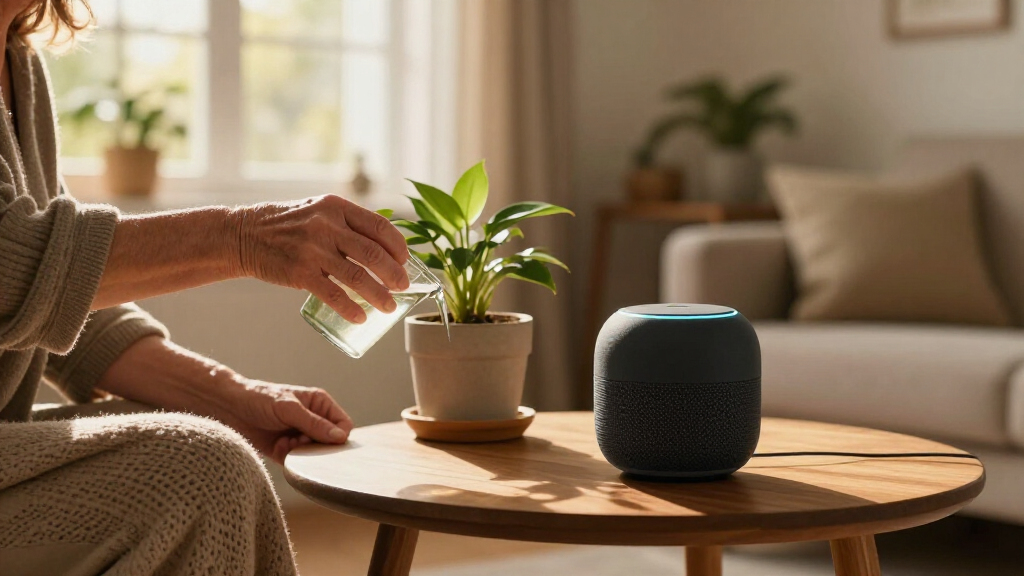

For most older adults, I’d start with the Amazon Echo Dot (5th Gen): it pairs a straightforward Alexa setup with a compact speaker and voice access to common tasks. The Echo Show 5 is a stronger fit when a small screen for calls, reminders or visual information would help, while the ANSTEN Wireless TV Speaker is aimed at a different need: clearer TV listening plus an SOS alarm. The tradeoff is between a simple speaker, a screen that adds useful controls but needs more interaction, and specialized devices that may not serve as a general smart-home hub. I compare all nine options by ease of use, accessibility, sound, setup demands and fit for different homes below.

Turn quiet afternoons into listening time
- Thousands of audiobooks, podcasts and originals
- Listen on your phone, tablet or Echo — also offline
- Cancel anytime
Complete the kit


Key Takeaways
- The Echo Dot (5th Gen) is the most balanced starting point in this lineup: it offers Alexa voice control without requiring a screen or a complex smart-home setup.
- The Echo Show 5 and Echo Show 11 serve different screen needs. The smaller model takes less space, while the 11-inch display gives more room for visual information and video calls.
- The ANSTEN is the specialized TV-and-alert choice, not a like-for-like smart speaker. Its SOS alarm and TV audio focus may suit a particular household need, but it should not be chosen for broad assistant features alone.
- Higher-end sound and Home Assistant flexibility bring extra complexity. Echo Dot Max may suit listeners prioritizing audio, while Third Reality’s Home Assistant device makes more sense for a technically confident household.
- Google options are a better fit for Google Assistant households. Nest Mini is compact, and Nest Audio gives sound more priority; the Japan-model, renewed Nest Mini listing makes sourcing and compatibility checks especially relevant.
| Third Reality Voice/Music Assistant Dev Edition for Home Assistant |  | Best for Home Assistant Households | Operating system: Linux | Processor: Quad-core ARM A53 | Memory and storage: 256 MB RAM; 512 MB flash | VIEW LATEST PRICE | See Our Full Breakdown |
| ANSTEN Wireless TV Speaker with SOS Alarm |  | Best for Clear TV Dialogue and Emergency Alerting | Audio output: Stereo | Wireless technology: 2.4 GHz | Wireless range: Up to 100 ft (30.48 m) | VIEW LATEST PRICE | See Our Full Breakdown |
| Amazon Echo Spot Smart Alarm Clock, Glacier White |  | Best Bedside Voice Assistant | Display: 2.83-inch touchscreen, 240 × 320 pixels | Speaker: 1.73-inch full-range built-in speaker | Camera: None | VIEW LATEST PRICE | See Our Full Breakdown |
| Amazon Echo Show 11 Smart Display, 11-Inch Full HD Touchscreen, Graphite |  | Best Large-Screen Smart Display | Display: 10.95-inch Full HD touchscreen, 1920 × 1200 resolution | Camera: 13 MP with auto framing | Audio: 1 × 2.8-inch woofer and 2 full-range drivers | VIEW LATEST PRICE | See Our Full Breakdown |
| Amazon Echo Show 5 Smart Display (Newest Model), Cloud Blue |  | Best Compact Display for Alexa and Video Calls | Display: 5.5 inches | Camera: 2 MP | Voice assistant: Alexa | VIEW LATEST PRICE | See Our Full Breakdown |
| Amazon Echo Dot (5th Gen) Smart Speaker with Alexa, Deep Sea Blue |  | Best Compact Alexa Pick | Generation: 5th Gen | Dimensions: 3.9 × 3.9 × 3.5 in (100 × 100 × 89 mm) | Weight: 10.7 oz (304 g) | VIEW LATEST PRICE | See Our Full Breakdown |
| Google Nest Mini (2nd Gen) Bluetooth Speaker, Charcoal, Japan Model (Renewed) |  | Best for Google Assistant Basics | Model: Google-Nest-Japan-2nd-Gen | Generation: 2nd Gen | Condition: Renewed | VIEW LATEST PRICE | See Our Full Breakdown |
| Amazon Echo Dot Max Smart Speaker with Alexa, Graphite |  | Best for Fuller Sound and Smart-Home Control | Dimensions: 4.27 × 4.27 × 3.9 in (108.7 × 108.6 × 99.2 mm) | Weight: 17.82 oz (505.3 g; 1.11 lb) | Drivers: 1 × 0.8 in tweeter; 1 × 2.5 in woofer | VIEW LATEST PRICE | See Our Full Breakdown |
| Google Nest Audio Bluetooth Speaker with LED Keychain, Chalk |  | Best for Google Assistant and Room-Filling Sound | Model: GA01420-US-LED | Color: Chalk | Audio output: Stereo | VIEW LATEST PRICE | See Our Full Breakdown |
| voice controlled smart speakers for senior | Dimensions | Weight |
|---|---|---|
| Third Reality Voice/Music Assi | 2.56 × 2.56 × 2.56 in | — |
| ANSTEN Wireless TV Speaker wit | 8.39 × 4.25 × 5.71 in | — |
| Amazon Echo Spot Smart Alarm C | 4.5 × 4.1 × 4.4 in (113 × 103 × 111 mm) | 14.3 oz (405 g) |
| Amazon Echo Show 11 Smart Disp | 10 × 5 × 7.2 in (255 × 127 × 182 mm) | 45.92 oz (1302 g) |
| Amazon Echo Show 5 Smart Displ | — | — |
| Amazon Echo Dot | 3.9 × 3.9 × 3.5 in (100 × 100 × 89 mm) | 10.7 oz (304 g) |
| Google Nest Mini | — | 0.45 kg |
| Amazon Echo Dot Max Smart Spea | 4.27 × 4.27 × 3.9 in (108.7 × 108.6 × 99.2 mm) | 17.82 oz (505.3 g; 1.11 lb) |
| Google Nest Audio Bluetooth Sp | 3.07 × 4.89 × 6.89 in | 1.74 kg |
More Details on Our Top Picks
Third Reality Voice/Music Assistant Dev Edition for Home Assistant
I’d choose the Third Reality Voice/Music Assistant Dev Edition for a senior whose family has already built a Home Assistant setup and can help maintain it. It combines dual microphones, a speaker, and preloaded Home Assistant Voice Assistant and Music Assistant, so it can capture commands and play spoken responses or audio without needing a separate voice endpoint. Compared with the Amazon Echo Dot (5th Gen), this is a more specialized choice: its appeal is Home Assistant integration and the ability to edit or flash firmware, not a familiar plug-and-play Alexa experience. That flexibility comes with a learning curve. Its 2.4 GHz-only Wi-Fi, 256 MB of RAM, and 512 MB of storage also make it less suited to buyers who want broad, polished features with little setup. I’d skip it unless someone can configure and support the system.
Pros:- Preloaded Home Assistant Voice Assistant and Music Assistant support a Home Assistant-centered setup.
- Dual digital microphones and a built-in speaker combine voice capture and audio playback in one compact unit.
- Firmware flashing, live logs, and on-device editing offer flexibility for a technically capable caregiver.
- Small 2.56-inch cube fits easily on a bedside table or shelf.
Cons:- Setup and ongoing support may be harder than with an Echo device, especially for seniors without technical help.
- 2.4 GHz Wi-Fi only may not fit every home network configuration.
- 256 MB RAM and 512 MB flash limit resources compared with general-purpose smart speakers.
Best for: Seniors whose family already uses Home Assistant and can set up, maintain, and troubleshoot a customizable voice device.
Not ideal for: Buyers seeking a simple mainstream assistant, broad consumer-service support, or a device they can configure without technical help.
- Operating system:Linux
- Processor:Quad-core ARM A53
- Memory and storage:256 MB RAM; 512 MB flash
- Microphones:Dual digital microphones
- Speaker:3 W, 4 Ω
- Connectivity:2.4 GHz Wi-Fi
- Dimensions:2.56 × 2.56 × 2.56 in
- Warranty:1 year
Our verdict“Choose this compact device for a Home Assistant household with technical support, but pick an Echo Dot for a more familiar, low-setup voice assistant.”
ANSTEN Wireless TV Speaker with SOS Alarm
The ANSTEN Wireless TV Speaker is the lineup’s most practical choice for a senior who mainly needs to hear television dialogue more clearly and wants a nearby alarm button. Voice highlighting, automatic gain control, and treble adjustment address speech audibility more directly than the Amazon Echo Show 5, which is a general-purpose Alexa display rather than a dedicated TV speaker. The portable unit can run for up to 10 hours and connects through optical, RCA, or AUX, giving it more flexibility with older TVs than a speaker that depends on smart-home audio features. Its SOS alarm can call attention to an emergency, but it is not described as a monitoring or emergency-response service. This also isn’t a voice-controlled assistant: it won’t answer questions or control smart devices by voice. HDMI-only TVs may need a separately purchased converter.
Pros:- Voice highlighting, automatic gain control, and treble adjustment are aimed at making TV speech easier to hear.
- Optical, RCA, and AUX inputs support a range of TV connections.
- Portable design offers up to 10 hours of playback and a wireless range up to 100 feet.
- SOS switch sounds an alarm for nearby assistance.
Cons:- It is a TV speaker, not a voice assistant, so it cannot answer spoken questions or control smart-home devices.
- An HDMI-only TV requires a separately purchased converter.
- It is not water resistant, and wired headphones are not included.
Best for: Seniors who struggle to hear television dialogue and want a portable speaker with an accessible alarm button, with a caregiver available to connect it to the TV.
Not ideal for: Buyers looking for Alexa or Google voice commands, smart-home control, or an emergency alert that contacts a response service.
- Audio output:Stereo
- Wireless technology:2.4 GHz
- Wireless range:Up to 100 ft (30.48 m)
- Battery life:Up to 10 hours
- Audio inputs:Optical, RCA, AUX 3.5 mm
- Headphone jack:Yes
- Charging options:Charging base or wall adapter
- Dimensions:8.39 × 4.25 × 5.71 in
Our verdict“Pick the ANSTEN for clearer TV dialogue and a local alarm button, not as a substitute for a voice-controlled smart speaker.”
Amazon Echo Spot Smart Alarm Clock, Glacier White
I’d place the Amazon Echo Spot on a bedside table for a senior who wants Alexa along with a glanceable clock, weather, and playback information. Its 2.83-inch touchscreen adds visual cues without taking up the space of the 11-inch Echo Show, while Alexa routines can support gradual wake-ups and compatible smart-home control. Compared with the Echo Show 5, the Spot’s rounder, clock-focused design is better suited to checking time and basic information at a glance; the Show 5 is the more capable pick for video calls and camera viewing. The Spot has no camera, which may appeal to someone who prefers fewer sensors in the bedroom, and it includes a microphone-off button. The tradeoff is a small display and a built-in speaker better suited to bedside listening than room-filling sound.
Pros:- Touchscreen displays clock faces and useful information such as weather and song titles.
- Alexa routines can support gradual wake-ups and compatible smart-home control.
- Built-in speaker plays music, podcasts, and audiobooks.
- No camera, plus a microphone-off button and app-based privacy controls.
Cons:- The 2.83-inch display is small for readers who need larger text or more screen space.
- Its 1.73-inch speaker is better suited to bedside listening than strong room-wide audio.
- Some features have device or service limits, and eero coverage extension requires a compatible eero router and linked accounts.
Best for: Seniors who want an Alexa bedside clock for voice requests, routines, weather, and casual music or podcast listening, without a camera.
Not ideal for: Buyers who need a large, easy-to-read screen, frequent video calls, or a more capable speaker for filling a room with sound.
- Display:2.83-inch touchscreen, 240 × 320 pixels
- Speaker:1.73-inch full-range built-in speaker
- Camera:None
- Wi-Fi:Dual-band 802.11a/b/g/n/ac, 2.4 and 5 GHz
- Bluetooth:A2DP and AVRCP support
- Dimensions:4.5 × 4.1 × 4.4 in (113 × 103 × 111 mm)
- Weight:14.3 oz (405 g)
- eero Built-in:Up to 1,000 sq. ft. additional coverage; compatible eero router required
Our verdict“Choose the Echo Spot for a camera-free Alexa bedside clock, but choose the Echo Show 5 for a larger display and video calling.”
Amazon Echo Show 11 Smart Display, 11-Inch Full HD Touchscreen, Graphite
The Echo Show 11 is the strongest fit here for a senior who benefits from a larger screen for video calls, photos, streaming, and compatible smart-home controls. Its 10.95-inch Full HD display gives more room to read and tap than the Echo Show 5, while the 13 MP camera with auto framing supports video calls without requiring the person to stay perfectly centered. The built-in Zigbee, Matter, and Thread hub can also simplify control of compatible devices; the Echo Spot is a better match for a compact bedside clock, but it doesn’t offer this large-screen experience. The tradeoff is its larger footprint and greater setup complexity for households that don’t already use compatible smart-home devices. Alexa features and device control still depend on service and compatibility, so the screen alone doesn’t guarantee a simpler setup.
Pros:- 10.95-inch Full HD touchscreen provides substantially more viewing and touch space than the Echo Show 5.
- 13 MP camera with auto framing supports video calls while allowing some movement.
- Built-in Zigbee, Matter, and Thread hub supports compatible smart-home devices.
- Microphone and camera disable controls offer direct privacy options.
Cons:- Its 10 × 5 × 7.2-inch footprint takes more space than compact options such as the Echo Spot.
- Smart-home features depend on compatible devices and services, which can add setup work.
- Bluetooth speakers requiring PIN codes are not supported.
Best for: Seniors who value a larger screen for video calls, viewing photos and content, and controlling a household with compatible smart-home devices.
Not ideal for: Buyers with limited counter or bedside space, those who prefer a simple audio-only speaker, or households without compatible devices that can use its hub.
- Display:10.95-inch Full HD touchscreen, 1920 × 1200 resolution
- Camera:13 MP with auto framing
- Audio:1 × 2.8-inch woofer and 2 full-range drivers
- Wi-Fi:Wi-Fi 6E (IEEE 802.11ax)
- Smart-home hub:Zigbee, Matter, and Thread Border Router
- Bluetooth:Version 5.4
- Dimensions:10 × 5 × 7.2 in (255 × 127 × 182 mm)
- Weight:45.92 oz (1302 g)
Our verdict“Choose the Echo Show 11 when screen size and video calls matter most; choose the Echo Spot or Echo Show 5 for a smaller bedside setup.”
Amazon Echo Show 5 Smart Display (Newest Model), Cloud Blue
The Echo Show 5 is a good middle ground for a senior who wants a small screen for Alexa, video calls, photos, and compatible camera feeds without giving up much table space. Unlike the Echo Dot (5th Gen), it can show weather, news, and images instead of relying on voice and audio alone. Compared with the Echo Show 11, it is easier to fit on a crowded nightstand, but the 5.5-inch display offers less room for reading or tapping. Its 2 MP camera supports video calls, and the camera shutter and mic/camera off button give the user physical privacy controls. I’d choose it for basic visual Alexa tasks rather than frequent long video calls or a household needing a large smart-home control panel. Some functions depend on compatible services, and unlimited cloud photo storage requires Prime membership.
Pros:- 5.5-inch screen displays news, weather, photos, shows, and compatible camera feeds.
- Alexa supports music streaming and compatible smart-home controls.
- 2 MP camera supports video calling and viewing compatible camera feeds.
- Physical camera shutter and mic/camera off button provide direct privacy controls.
Cons:- The 5.5-inch display offers less viewing and touch space than the Echo Show 11.
- Some functions rely on compatible devices or services.
- Unlimited cloud photo storage requires Prime membership.
Best for: Seniors who want a compact Alexa display for bedside information, occasional video calls, photos, and compatible camera feeds.
Not ideal for: Buyers who need a larger screen for readability, make frequent video calls, or want unlimited cloud photo storage without Prime membership.
- Display:5.5 inches
- Camera:2 MP
- Voice assistant:Alexa
- Privacy features:Mic/camera off button and built-in camera shutter
- Color:Cloud Blue
- Recycled fabric:100% post-consumer recycled polyester yarn
- Recycled aluminum:100% recycled aluminum
- Packaging:100% recyclable
Our verdict“Choose the Echo Show 5 for a small Alexa screen with video calling, but pick the Echo Show 11 if readability and viewing space take priority.”
Amazon Echo Dot (5th Gen) Smart Speaker with Alexa, Deep Sea Blue
I’d choose the Echo Dot (5th Gen) for someone who wants everyday voice help in a small footprint: it can set alarms and timers, play audiobooks or podcasts, and control compatible smart-home devices. Its microphone-off button gives the listener a direct way to disable voice pickup, while built-in motion and temperature sensors can support routines without requiring a separate sensor. Compared with the larger Echo Dot Max, this model takes up less space but gives up the Max’s stronger bass, room-adaptive audio, and broader built-in smart-home hub. The Dot Max is the better fit for sound and device coverage; this Dot makes more sense when simple voice tasks matter more than fuller playback. A drawback for some households is setup complexity: eero extension needs compatible equipment, and some services or skills may cost extra.
Pros:- Handles voice requests for music, audiobooks, podcasts, alarms, and timers.
- Built-in motion and temperature sensors can support compatible smart-home routines.
- Microphone-off button provides a straightforward privacy control.
- Bluetooth streaming and compatible Echo pairing offer flexible playback options.
Cons:- Its single full-range driver and mono playback are less suited to room-filling sound than the Echo Dot Max or Google Nest Audio.
- eero Built-in requires a compatible eero router, linked accounts, and setup in the eero app.
- Some Alexa skills and services may require subscriptions or additional fees.
Best for: Older adults who want a compact Alexa speaker for alarms, spoken requests, audiobooks, and basic compatible smart-home routines.
Not ideal for: Listeners who want fuller room-filling sound or a smart-home hub with Zigbee and Thread support; the Echo Dot Max is better equipped for those needs.
- Generation:5th Gen
- Dimensions:3.9 × 3.9 × 3.5 in (100 × 100 × 89 mm)
- Weight:10.7 oz (304 g)
- Audio bandwidth:62 Hz–19 kHz
- Speaker driver:1.6 in full-range driver
- Playback:Mono
- Wi-Fi:Dual-band 802.11a/b/g/n/ac (2.4 and 5 GHz)
- Smart-home compatibility:Wi-Fi, Bluetooth Low Energy Mesh, Matter
- Color:Deep Sea Blue
Our verdict“Choose this compact Echo Dot for accessible Alexa voice tasks and simple routines, but pick the Echo Dot Max if sound or smart-home hub features matter more.”
Google Nest Mini (2nd Gen) Bluetooth Speaker, Charcoal, Japan Model (Renewed)
The Google Nest Mini (2nd Gen) suits someone who mainly wants spoken access to news, music, alarms, timers, and personalized reminders through Voice Match. That personalization can help distinguish household members’ requests, while the compact tabletop design is less imposing than the Google Nest Audio. The tradeoff is that this listing is a renewed Japan model with a 90-day limited warranty, so buyers should be comfortable checking regional compatibility and accepting a shorter warranty than they may want for a household device. It also needs corded power and is not waterproof. Compared with the Alexa-based Echo Dot (5th Gen), this Mini is a better match for a household already using Google Assistant, but it offers fewer product details here about connectivity and smart-home compatibility.
Pros:- Voice controls cover everyday requests such as news, music, alarms, and timers.
- Voice Match supports personalized responses, reminders, and news.
- Compact tabletop form takes up less space than the Google Nest Audio.
- Listed with enhanced bass and 15-watt maximum output power.
Cons:- Renewed condition and a 90-day limited warranty may not suit buyers seeking longer-term assurance.
- Requires corded power, so it cannot be moved freely without an outlet.
- Not waterproof, limiting placement near sinks or other wet areas.
Best for: Google Assistant households seeking a small tabletop speaker for spoken news, timers, alarms, and personalized reminders.
Not ideal for: Buyers who want a longer warranty, a portable battery-powered speaker, or a product listing with clearly specified Wi-Fi and smart-home compatibility.
- Model:Google-Nest-Japan-2nd-Gen
- Generation:2nd Gen
- Condition:Renewed
- Speaker type:Portable Bluetooth speaker
- Maximum output power:15 watts
- Weight:0.45 kg
- Power source:Corded electric
- Waterproof:No
- Warranty:90 days limited
Our verdict“Pick this renewed Nest Mini for basic personalized Google Assistant requests in a compact spot, provided its regional model and short warranty suit your needs.”
Amazon Echo Dot Max Smart Speaker with Alexa, Graphite
I’d put the Echo Dot Max first for seniors who want Alexa voice control alongside stronger playback and a more capable smart-home base. Its woofer, tweeter, and room-adaptive audio are intended to deliver fuller sound than the smaller Echo Dot (5th Gen), which can help spoken content and music fill a room without choosing a larger standalone speaker such as the Google Nest Audio. The built-in hub supports Zigbee, Matter, and Thread, reducing the need for separate smart-home hardware for compatible devices. The tradeoff is greater size and weight than the standard Dot, and its eero extension is conditional: it needs a compatible router and supports up to 100 Mbps with 10 or fewer connected devices in the 5 GHz band. Buyers who only need alarms and simple requests may not need these extras.
Pros:- Room-adaptive playback and a woofer-tweeter setup offer fuller sound than the Echo Dot (5th Gen).
- Built-in hub supports Zigbee, Matter, and Thread Border Router functions.
- Supports multi-room speaker pairing and compatible Fire TV home-theater pairing.
- Can add eero coverage for compatible networks.
Cons:- Larger and heavier than the Echo Dot (5th Gen), making it less suited to tight bedside or countertop spaces.
- eero Built-in needs a compatible eero router and has stated speed and connected-device limits.
- Its broader audio and smart-home capabilities may be unnecessary for buyers who only need alarms, timers, and simple voice assistance.
Best for: Seniors who want Alexa, room-filling audio, and built-in support for compatible Zigbee, Matter, and Thread smart-home devices.
Not ideal for: Buyers who want the smallest, simplest speaker for alarms and occasional voice requests, or who lack compatible eero equipment but expect Wi-Fi extension.
- Dimensions:4.27 × 4.27 × 3.9 in (108.7 × 108.6 × 99.2 mm)
- Weight:17.82 oz (505.3 g; 1.11 lb)
- Drivers:1 × 0.8 in tweeter; 1 × 2.5 in woofer
- Playback:Two-way mono
- Audio processing:Lossless High Definition; Automatic Room Adaptation
- Wi-Fi:Wi-Fi 6E (IEEE 802.11ax)
- Smart-home hub:Zigbee, Matter, Thread Border Router
- Bluetooth:Bluetooth Low Energy 5.3; A2DP and AVRCP support
- Processor:AZ3 with AI Accelerator
Our verdict“Choose the Echo Dot Max when stronger sound and built-in smart-home control justify its larger footprint and eero requirements.”
Google Nest Audio Bluetooth Speaker with LED Keychain, Chalk
The Google Nest Audio is the sound-focused Google Assistant pick: its listed 30-watt output, woofer, tweeter, and tuning software are aimed at filling a room more confidently than the compact Nest Mini. Voice features include queries, broadcasts, and intercom conversations with compatible Nest devices, giving households a way to communicate between rooms without relying only on phone calls. Compared with the Echo Dot Max, this model suits buyers already using Google’s assistant, while the Echo offers a built-in Zigbee, Matter, and Thread hub that the Nest Audio listing does not specify. The Nest Audio is also heavier than either small Dot, needs corded power, and is not water resistant. The included LED keychain is an accessory, not a substitute for any accessibility feature or speaker control.
Pros:- 30-watt output with a woofer, tweeter, and tuning software is suited to room-filling playback.
- Google Assistant supports voice queries and broadcasts.
- Intercom conversations work with compatible Nest devices.
- Bluetooth enables music streaming from compatible devices.
Cons:- At 1.74 kg, it is substantially heavier than compact choices such as the Google Nest Mini.
- Requires corded electric power and is not water resistant.
- The listed details do not specify a built-in Zigbee, Matter, or Thread hub like the Echo Dot Max.
Best for: Google Assistant households that want stronger room-filling audio and voice broadcasts or intercom communication between compatible Nest devices.
Not ideal for: Buyers who need a compact speaker, battery-powered portability, water resistance, or a clearly specified built-in smart-home hub.
- Model:GA01420-US-LED
- Color:Chalk
- Audio output:Stereo
- Maximum output power:30 watts
- Connectivity:Bluetooth
- Dimensions:3.07 × 4.89 × 6.89 in
- Weight:1.74 kg
- Mounting type:Tabletop
- Water resistance:Not water resistant
Our verdict“Choose the Nest Audio for room-filling sound and Google Assistant intercom features, but choose the Nest Mini for a smaller, simpler speaker.”

How We Picked
I ranked these devices by how well they can serve everyday needs for an older adult: dependable voice interaction, clear and useful audio, approachable setup, and features that reduce reliance on small controls. I also weighed whether the device suits a specific purpose, such as video calls, TV listening, visual reminders or integration with a more advanced home-automation system. A product with more features did not automatically rank higher; features only helped when they were likely to make daily use easier.
The order favors options that offer a practical balance for a broad range of households, followed by devices that serve narrower needs or require more setup. The Echo Dot (5th Gen) ranks ahead of more specialized picks for its simpler speaker-first format, while displays earn consideration when their visual features add value. I treat the ANSTEN TV speaker and the Third Reality Home Assistant device as purpose-specific options, and I flag the renewed Japan-model Nest Mini as a choice where buyers should confirm sourcing and compatibility before purchase.
Factors to Consider When Choosing Voice Controlled Smart Speakers For Seniors
Choosing for a senior is less about finding the device with the longest feature list and more about matching the speaker to how the person communicates, listens and gets help. I’d make the decision with the intended user, and check the home’s Wi-Fi, phone ecosystem and support needs before ordering.
Decide Whether Voice Alone or a Screen Helps More
A speaker can reduce the need to find buttons, but voice commands are not always convenient or understood correctly. A display adds visual confirmation, readable prompts and a surface for calls or reminders, yet it also introduces touch controls and more settings. Ask whether the intended user prefers spoken instructions, large visual cues, or both. A screen may be useful for someone who benefits from seeing who is calling, while a speaker-only unit can be less distracting and easier to place. Avoid choosing a display simply because it appears more capable; the added interface only helps if it will be used. Also check whether the display’s placement and viewing angle suit the room.
Match the Assistant to Existing Phones and Services
Smart speakers work best when their assistant fits the person’s existing devices and habits. Before buying, check whether family members can help manage the account, set reminders and troubleshoot through the same platform. A household already using Alexa devices may find an Echo easier to support, while a Google-focused home may prefer a Nest speaker. Mixing platforms can split routines and complicate support, even if each device works on its own. Confirm which calling, music and smart-home services are available in the buyer’s region. For listings tied to a different market or sold renewed, verify language, account and connectivity compatibility rather than assuming the model will behave like a locally sold unit.
Treat Emergency Features as a Separate Safety Decision
A voice assistant or SOS-labeled device should not be assumed to provide monitored emergency response. Check exactly what an alert does, who receives it, whether it needs a phone or subscription, and whether it works during an internet or power outage. If a household needs dependable emergency coverage, compare the speaker with dedicated alert services and discuss the plan with caregivers. Voice activation can be useful when a device is within hearing range, but it may fail if the user cannot speak clearly or the room is noisy. Keep a second way to contact help available. The right choice depends on the support system around the senior, not just the words printed on a product listing.
Check Room Acoustics and Listening Needs
Small speakers are convenient for a bedside table or kitchen counter, but room size, background noise and hearing needs affect how useful they are. A compact device may be enough for spoken reminders and casual listening, while a larger speaker can make music and audio more prominent. Think about where the person will speak to the assistant and whether the speaker will be near a television, fan or busy household area. Place it within easy voice range, away from obstructions, and test whether the response volume is comfortable without being startling. If television dialogue is the main problem, a TV-focused audio product may fit better than a general assistant speaker. Do not assume stronger music performance automatically means clearer speech at every distance.
Plan Setup, Privacy and Ongoing Support
Setup can require a smartphone, an account, Wi-Fi credentials and permission choices, so decide who will handle the first configuration and future changes. Set a simple device name and practice a few useful commands together rather than introducing many routines at once. Review microphone controls, camera settings on display models, voice history options and calling permissions with the user. A device placed in a shared room may hear conversations or be activated by someone else, so location and household expectations matter. Consider who can update the network or recover the account if the original helper is unavailable. A slightly less feature-rich speaker may be the better purchase if local family support is familiar with its ecosystem.
Choose Features That Will Be Used, Not Just Available
Make a short list of real tasks: setting medication reminders, asking for weather, calling a family member, listening to radio or controlling lights. Then check that the device and relevant services support those tasks in the buyer’s region and account setup. Avoid paying for advanced home-automation flexibility when nobody plans to configure it, or for a display when the person does not want to interact with one. Conversely, a caregiver-supported household may benefit from features that make calls or shared reminders easier. Start with one or two routines and expand only if the user finds them helpful. Simplicity is a practical feature when it makes the speaker more likely to be used every day.
Frequently Asked Questions
Is a smart speaker a safe replacement for a medical alert device?
No. A smart speaker can support calls, reminders or voice requests, but its response depends on power, internet access, microphone pickup and the configured service. An SOS label alone does not confirm that trained operators monitor alerts or that emergency services are contacted. Check the exact alert pathway and any service requirements before relying on it. If emergency response is a concern, compare it with dedicated medical alert options and keep a backup way to call for help.
Should I choose an Echo Show or a speaker without a screen?
Choose a screen when visual information, video calls or visible controls are likely to help the person. A speaker-only model can be a better match when the goal is hands-free answers and audio without another interface to learn. The screen also raises practical questions about placement, camera privacy and whether text is comfortable to read from the intended seat or bed. Ask the user which way they prefer to interact rather than deciding on their behalf. If uncertain, a simpler speaker is often an easier first device, while a display suits a clear visual or calling need.
Can family members set up and manage a smart speaker for a senior?
Often, a family member can help with initial setup, account linking, contacts and reminders, but the exact controls depend on the assistant and its services. Agree who will manage passwords, network changes and privacy settings before the speaker becomes part of a daily routine. Keep the setup tied to an account the household can recover, with the senior’s consent and understanding. Practice a few common commands together and write down simple instructions near the device if helpful. A familiar platform can make ongoing support easier than adding a different ecosystem without a clear reason.
Will a smart speaker understand someone with a soft voice or speech impairment?
Voice recognition can vary with speaking volume, pronunciation, room noise and the distance from the device, so no model should be assumed to work equally well for everyone. Try the speaker in the room where it will be used and test the specific commands the person needs. A display can offer touch input or visual feedback in some situations, though it still requires interaction with the screen. Keep the unit unobstructed and close enough to hear speech without placing it where accidental activation is likely. If voice control remains unreliable, retain a phone, remote or other accessible control method.
What should I check before buying a renewed or region-specific smart speaker?
Confirm the seller’s return terms and the device’s condition, then verify its power requirements, language options, assistant availability and compatibility with local accounts. A region-specific model may have different software features or setup expectations than the version sold locally. Renewed devices can also vary in included accessories and cosmetic condition, so read the listing details closely. Check that the speaker can join the buyer’s Wi-Fi and work with the services the household plans to use. If any of those details are unclear, a locally supported model may be the less troublesome choice.
Conclusion
For most buyers, my best overall recommendation is the Amazon Echo Dot (5th Gen), which offers a straightforward speaker-first route to Alexa. The best value in practical features is the Echo Show 5 for someone who will use its compact screen for calls or visual prompts; choose the Dot instead if a screen would go unused. For best premium, the Echo Dot Max is the sound-focused option, while the Echo Show 11 makes more sense when a larger display matters more than a speaker-only design. The best for beginners is the Echo Dot, provided someone can assist with setup. For specific needs, I’d pick the ANSTEN for its TV audio and SOS-oriented role, the Third Reality device for a technically capable Home Assistant household, or a Google Nest model when Google Assistant is already part of the home. Match the ecosystem and daily task first; added features are only an advantage when the intended user can comfortably use them.