
Vive 4 Wheel Mobility Scooter
- ✔ Maximum weight capacity: 265 pounds
- ✔ Maximum speed: 3.7 mph
- ✔ Driving distance: 12.4 miles per charge

Turn quiet afternoons into listening time
- Thousands of audiobooks, podcasts and originals
- Listen on your phone, tablet or Echo — also offline
- Cancel anytime
Why This Product Stands Out
The Vive’s clearest point of difference is its transport-friendly disassembly. Many four-wheel scooters are built around stability and practical daily travel, but portability becomes a separate challenge when the scooter must fit in a car or be stored between outings. The Vive addresses that need by separating into sections, including a 29-pound rear section. That is a more manageable transport approach than lifting a complete scooter, though it still asks the user or a helper to handle substantial pieces. Buyers should check whether they can lift and stow each section before treating it as a travel-ready solution. Within the segment, its 3.7 mph speed and 12.4-mile stated range place it toward practical local mobility rather than extended touring or fast outdoor travel. Those numbers are adequate for errands and shorter trips for many users, but they are not a reason to choose it over scooters with higher speeds or longer ranges. Its padded adjustable swivel seat and straightforward controls make the package more approachable for routine use. The scooter stands out most when compact storage and uncomplicated operation matter more than pace, capacity, or all-day range.Key Features and What They Mean
Disassembly for storage and car transport helps people who cannot leave a scooter assembled at home or at their destination. Separating it into sections can make it possible to fit the scooter into a vehicle and store it in a smaller space, supporting outings that might otherwise be impractical. This feature benefits car users with limited storage most, provided they can lift and reassemble the pieces. The 29-pound rear section gives buyers a concrete weight to compare with their own lifting ability or a helper’s availability.
The adjustable padded seat with swivel function can make two common parts of a ride easier: settling into a comfortable position and transferring on or off the scooter. Riders who have difficulty twisting or stepping into a fixed seat may benefit most from turning the seat toward a chair or doorway before standing. Adjustability lets users fine-tune their seated position, while the 15.75-inch width helps them assess fit. Since comfort varies, people expecting long periods seated should try the seat when possible.
The control panel and battery indicator support more confident everyday use. Straightforward controls may help new riders learn to start, stop, and turn without a complicated setup, while the visible battery display makes it easier to check charge before leaving. That can help users plan local errands and avoid setting out without enough battery for the return. The indicator does not extend the range, so riders still need to allow a margin for route changes and real-world battery use.
The 12.4-mile stated range and 3.7 mph maximum speed define the scooter’s practical role. The stated range may let a rider complete nearby errands or a planned outing without charging between stops, while the moderate speed can suit someone who travels at an unhurried pace. These figures are most relevant to people comparing the scooter with their regular routes: actual distance varies with use and conditions, so the full range is not guaranteed for every trip. Riders who travel farther or need to keep up with a brisk companion may benefit more from a model with greater range or speed.
The scooter supports up to 265 pounds and has 8-inch tires. Checking the capacity against the rider’s weight and belongings helps buyers confirm basic fit before purchase. The scooter is described for smooth indoor and rougher outdoor surfaces, which may let a rider use it for ordinary routes beyond the home. The tire size alone does not show how it handles every path, curb, or uneven surface; people whose regular routes include demanding terrain should confirm that the scooter is suited to those conditions.
Performance and Real-World Use
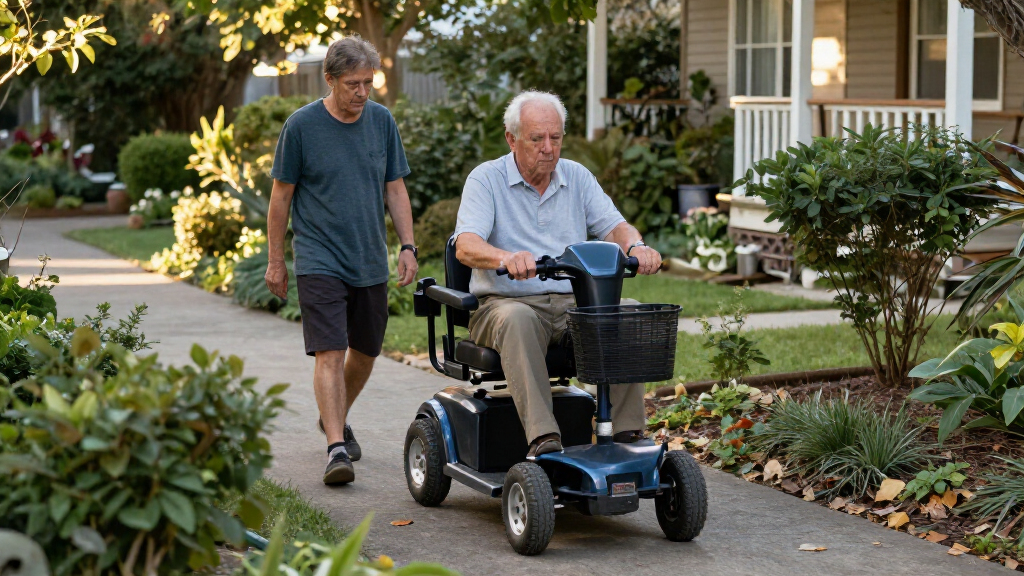
In day-to-day use, the Vive is likely to make the most sense for short, familiar routes where a simple control layout and a comfortable seat matter more than speed. Its maximum of 3.7 mph is modest, so crossing larger areas or keeping pace with a brisk companion may take patience. The battery indicator can help with basic trip planning, but riders should leave a margin for changes to the route and avoid treating the stated range as a precise promise for every outing. The four-wheel setup and stated use on both smooth indoor and rougher outdoor surfaces give it a broader role than an indoor-only scooter. Even so, a buyer should match the route to the machine: the 8-inch tires and product description do not establish suitability for every rough path or obstacle. For predictable errands, home use, and ordinary outdoor routes, the combination may be practical. Frequent travel over demanding terrain calls for a model explicitly suited to that use. Transport adds a practical step. Disassembly reduces the burden of moving the whole scooter, but it does not remove lifting, storage, or reassembly from the routine. The 29-pound rear section can be a challenge for someone with limited strength or no helper, and the assembled scooter is described as heavy. Before buying for car trips, consider the vehicle’s available space and who will load the sections. That check can determine whether its portability advantage works in real life.Who Should Buy This
The Vive is best suited to a rider who needs a four-wheel scooter for home use, nearby errands, and shorter planned outings, has a route that fits within a modest range, and values a seat that swivels and adjusts. It is especially worth considering if the scooter must be stored in a limited space or transported in a vehicle and the rider or a helper can handle its separated sections. The buyer should also fit within the 265-pound capacity and be comfortable with a 3.7 mph maximum speed.Who Should Skip This
Look elsewhere if the rider regularly covers long distances, needs more than a 3.7 mph top speed, or wants ample range for a full day of spontaneous travel. It is also a weak fit for someone who must load the scooter alone but cannot manage a 29-pound rear section, or who needs a capacity above 265 pounds. If routes include demanding terrain, compare a scooter designed for that use rather than assuming this model will manage every rough surface.Value for Money
The Vive makes its strongest value case through transport flexibility, an adjustable swivel seat, and accessible controls. Those are useful benefits for a buyer whose main need is a compact, manageable scooter for regular short trips. Its value is less convincing for riders who would pay for portability but rarely transport the scooter, or who would quickly outgrow its range and speed. A higher-speed 4-wheel alternative listed with a 4.7 mph top speed and the same 12.4-mile stated range may suit buyers who prioritize pace; a 45-mile-range option is a more relevant comparison for longer journeys. The Vive is worth choosing when its disassembly and seating fit the buyer’s routine, not as a general-purpose choice for every mobility need.Vive 4 Wheel Mobility Scooter
The Vive’s clearest point of difference is its transport-friendly disassembly . Many four-wheel scooters are built around stability and practical daily travel, but portability becomes a separate challenge when the scooter must fit in a car or be stored between outings.
Pros:
- Disassembles for transport: Breaking the scooter into sections can make it easier to store in a vehicle or at home than moving it as one assembled unit.
- Adjustable padded swivel seat: The seat can make getting on and off more manageable and lets riders adjust their position for everyday comfort.
- Simple controls and battery indicator: An intuitive control panel can reduce the learning curve, while the indicator helps riders keep an eye on charge before heading out.
- 12.4-mile stated range: That distance can cover many local errands and shorter outings when the route, rider, and conditions suit the scooter.
- Four-wheel design for mixed surfaces: The scooter is intended for smooth indoor floors and rougher outdoor surfaces, giving users more flexibility than a mobility aid meant only for indoor travel.
Cons:
- 3.7 mph top speed: Riders who need to keep pace with faster pedestrians or cover ground quickly may find the scooter slow.
- Range has limits: The stated 12.4 miles may not cover a full day of longer outings, particularly if a trip leaves little room for variation in route or battery use.
- Heavy when assembled: Disassembly helps with transport, but moving the intact scooter can still be difficult, and the rear section alone weighs 29 pounds.
- 265-pound capacity: Buyers need to account for the rider’s weight and any carried items; people who need more capacity should look at a higher-capacity model.
Best for: People seeking a manageable scooter for indoor use and shorter outdoor trips who can transport its separated sections.
Not ideal for: Riders who need higher speeds, longer outings between charges, or a scooter they can lift and load without help.
Bottom line: The Vive 4 Wheel Mobility Scooter is recommended for riders who need home mobility, nearby errands, or shorter planned outings and can make use of its disassembly for storage or car transport.
Frequently Asked Questions
Is the Vive 4 Wheel Mobility Scooter suitable for longer trips?
Its 12.4-mile stated range can suit shorter outings and local errands, but it may leave too little margin for longer days away. Range varies with use and conditions, so riders who routinely travel farther should compare models with a longer stated range.
Can one person load it into a car?
It disassembles into sections, which can make transport more practical than lifting the complete scooter. The rear section weighs 29 pounds, so solo loading depends on the person’s strength, lifting ability, and vehicle height. Plan around the weight of every section before buying.
Is 3.7 mph fast enough for everyday use?
That top speed can work for a moderate pace on local trips, but it may feel slow for riders who want to keep up with faster walkers or cover ground quickly. If speed is a key need, consider a model listed at 4.7 mph or another faster option.
What weight limit should buyers check?
The scooter’s maximum capacity is 265 pounds. Buyers should include carried items in their planning and choose a model with a higher capacity if the rider and belongings could exceed that limit.
Final Thoughts
The Vive 4 Wheel Mobility Scooter is recommended for riders who need home mobility, nearby errands, or shorter planned outings and can make use of its disassembly for storage or car transport. It is a good fit when the route works within the 12.4-mile stated range, a 3.7 mph top speed is sufficient, the rider is within the 265-pound capacity, and the rider or a helper can manage the separated sections. Buyers who need faster travel, longer range, more capacity, or a scooter that is easy to load without lifting should look elsewhere.Fall Picks
fall essentials
As an affiliate, we earn on qualifying purchases.