TL;DR

Turn quiet afternoons into listening time
- Thousands of audiobooks, podcasts and originals
- Listen on your phone, tablet or Echo — also offline
- Cancel anytime
Yoga teacher Alina Boyett has outlined a four-movement recovery flow that can be done at home without equipment or prior yoga experience. The sequence uses gentle poses for the legs, hips, back and shoulders; Boyett advises moving within a comfortable range and not pushing through pain.
Yogalina Studios founder Alina Boyett has shared a four-pose, beginner-friendly yoga flow for people seeking gentle movement after exercise or a day spent sitting. Published by Fit&Well, the equipment-free sequence focuses on the legs, hips, spine and shoulders, with Boyett advising readers to move slowly and avoid forcing stretches.
The sequence has one round of waterfall pose and child’s pose, followed by two rounds each of a ragdoll forward fold and seated spinal twist. Boyett recommends holding the first two poses for three to five breaths, the forward fold for three to five breaths per round, and each side of the twist for two to three breaths.
To begin, lie on your back near a wall and rest your legs up against it, allowing a slight bend in the knees if needed. For child’s pose, start on hands and knees, bring the big toes together, separate the knees gently and lower the hips toward the heels. Extend the arms forward and rest the forehead on the floor if comfortable.
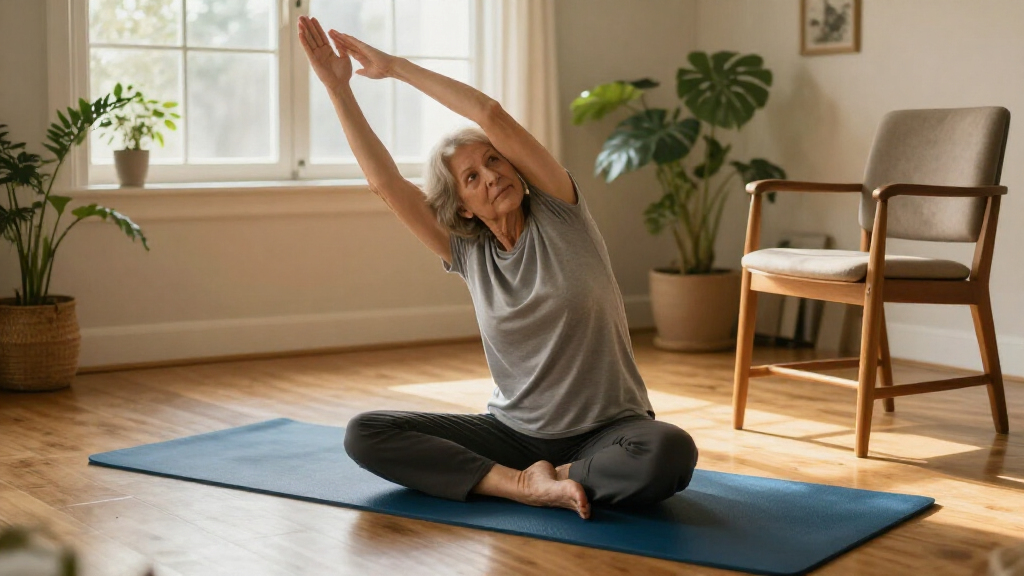
For the forward fold, stand with feet about hip-width apart, soften the knees and hinge forward from the hips, letting the head and arms hang. The final movement is a seated twist: sit with legs crossed or extended, lengthen the spine, place one hand behind you and the other on the opposite knee, then rotate gently. Repeat on the other side. The source describes the movements; it does not report a clinical test of their effects.
A Short Routine for Recovery Days
The report frames recovery as part of a balanced exercise routine, rather than as simply stopping activity. For readers who have finished a workout, gone for a run or spent extended time at a desk, the sequence offers a structured way to pause and move gently without needing equipment or advanced yoga skills.
Its practical value is its low-barrier format: the poses are presented with breath-based holds and straightforward instructions, and several can be modified by softening the knees or choosing a comfortable seated position. The guidance is not a promise of improved flexibility or a treatment for pain. Boyett’s comments about how the movements may feel are her professional perspective, not reported medical findings.
Products Worth Considering

Oral-B iO Series 5 Rechargeable Electric Toothbrush with Travel Case and 3 Brush Heads, Black

BowFlex Results Series SelectTech Dumbbells

LEVOIT Vital 100S-P Smart Air Purifier with Washable Pre-Filter
As an affiliate, we earn on qualifying purchases.
Boyett’s Approach to Gentle Movement
Boyett told Fit&Well that recovery deserves attention alongside training effort. She said the four poses were selected to address areas that commonly feel tense after exercise, including the legs, hips, spine and shoulders. Yoga teacher Misha Clarke demonstrates the sequence in the video accompanying the report.
The flow combines a resting posture, a kneeling forward stretch, a standing fold and a seated rotation. The source presents it as suitable for beginners and people without equipment, while emphasizing that the intention is to move within one’s own range rather than achieve a particular depth in a pose.
Limits of the Reported Benefits
The supplied report does not include a clinical study, participant data or measurements showing that this particular flow improves flexibility, speeds recovery or relieves pain. Benefits such as easing tension, relaxing tired legs and encouraging calm are attributed to Boyett’s explanations and should not be read as established outcomes for every person.
The material also does not specify modifications for every injury, medical condition or mobility limitation. Whether a pose is appropriate can vary by individual; the sequence is not presented as medical treatment or individualized advice.
How to Approach the Four Poses
Readers who choose to try the flow can follow the order and breath counts in the Fit&Well report, moving gently and adjusting or skipping a position that does not feel comfortable. Boyett’s guidance is to avoid forcing a stretch or continuing through pain. People with an injury or relevant medical condition should seek professional guidance before trying it.
The source material does not announce a follow-up study, new program or other next development. The immediate next step described is simply to use the instructions and demonstration video as a guide, while keeping movement within a comfortable range.
Key Questions
What does the beginner-friendly yoga flow include?
It includes waterfall pose, child’s pose, a ragdoll forward fold and a seated spinal twist. The source gives breath-based holds for each movement.
Do you need equipment or yoga experience?
The report describes the sequence as suitable for home practice without equipment or previous yoga experience. A wall is used for the waterfall pose.
How long should the poses be held?
Boyett suggests three to five breaths for waterfall and child’s pose, three to five breaths for each round of the forward fold, and two to three breaths on each side of the twist.
Is the routine proven to treat pain or improve flexibility?
The supplied report does not provide clinical evidence or measured results for the sequence. It presents Boyett’s recommendations and descriptions, not a proven treatment for pain or a guaranteed way to improve flexibility.
What should someone do if a pose hurts?
Boyett says not to force a stretch or push through pain. Anyone with an injury or relevant medical condition should seek appropriate professional guidance before trying the sequence.
Source: rss