Indoor fall prevention alert systems range from simple caregiver pagers to monitored medical alert services, and the right choice depends on who needs to respond and how quickly. I’d name the ADT Medical Alert Plus In-Home Emergency Response System with Fall Detection best overall for households seeking a direct route to emergency help, while Nomo Smart Care stands out for connected home monitoring and the Smart Caregiver Wireless Floor Mat Alarm for a targeted alert near a bed or doorway. The main tradeoffs are professional monitoring versus alerts to a nearby caregiver, and broad coverage versus a sensor designed for one activity or location. Wireless range, false alarms, setup, and what happens during a power or internet outage also affect the decision. Read on for the full breakdown of all 15 options and guidance on matching a system to your home and care plan.

Turn quiet afternoons into listening time
- Thousands of audiobooks, podcasts and originals
- Listen on your phone, tablet or Echo — also offline
- Cancel anytime
Complete the kit


Key Takeaways
- Monitoring changes the job the system does: ADT is the standout for a household seeking a professional response path, while most pagers and sensor kits alert someone nearby rather than summon help themselves.
- Sensor placement matters more than sensor count: Bed-exit alarms, floor mats, and motion detectors cover different moments and locations; a sensor aimed at the wrong route can leave a key gap.
- Connected features add dependence as well as convenience: Nomo, EverNary’s Wi-Fi model, and TurboSense offer app or network-linked functions, while simpler pager systems can avoid some internet-related complications.
- Bedside options are not interchangeable: Lunderg’s early-alert approach and Smart Caregiver’s pad-and-monitor setup serve different caregiver routines, so fit, placement, and the resident’s willingness to use them matter.
- Repeated product types make like-for-like checks useful: The lineup includes two EverNary motion-pager entries and several wireless bed or motion alarms; compare included sensors, alert styles, and connectivity rather than relying on similar product names.
| EverNary Wireless Caregiver Pager with Motion Sensor |  | Best for Room-Entry Alerts | Included components: 1 plug-in receiver and 1 motion sensor | Motion detection range: Up to 16.4 feet | Detection angle: 110° | VIEW LATEST PRICE | See Our Full Breakdown |
| ADT Medical Alert Plus In-Home Emergency Response System with Fall Detection |  | Best for Professional Emergency Monitoring | System type: In-home medical alert system | Fall detection: Automatic, through compatible ADT Medical Alert Pendant | Monitoring: 24/7 professional monitoring; required | VIEW LATEST PRICE | See Our Full Breakdown |
| Nomo Smart Care Medical Alert System with Fall Detection |  | Best for Whole-Home Smart Coverage | Included components: Smart Hub, 2 Satellite range extenders, and wearable Tags | Connectivity: Wireless WiFi | Power: AC power with battery backup | VIEW LATEST PRICE | See Our Full Breakdown |
| Smart Caregiver Wireless Floor Mat Alarm and Pager System, 24 x 48 in | 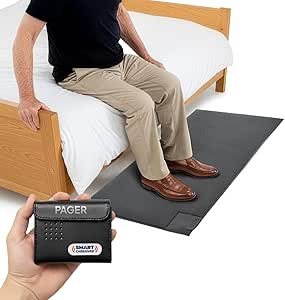 | Best for Bedside or Exit Monitoring | Included components: Caregiver pager (TL-2020P) and wireless floor mat (PTFM-07C) | Mat dimensions: 48 × 24 × 0.5 inches | Wireless range: Up to 300 feet | VIEW LATEST PRICE | See Our Full Breakdown |
| Lunderg Wireless Early-Alert Bed Alarm System for Caregivers |  | Best for Early Bed-Exit Warnings | Sensor pad size: 10 × 33 inches | Sensor technology: Lunderg Pre-Alert Smart Sensor Technology | Sensor pad construction: Soft foam interior; incontinence-resistant | VIEW LATEST PRICE | See Our Full Breakdown |
| Smart Caregiver Bed and Chair Exit Alarm System with Monitor and Sensor Pads |  | Best for Bed-and-Chair Coverage | Brand: Smart Caregiver Corporation | Included sensor pads: 10 × 30-inch bed pad; 10 × 15-inch chair pad | Pad material: Soft vinyl with foam interior | VIEW LATEST PRICE | See Our Full Breakdown |
| EverNary Wi-Fi Bed and Motion Sensor Alarm with App |  | Best for Smartphone Alerts and Expandable Coverage | Brand and model: EverNary AMZ01 | Included components: 2 motion sensors; 1 Wi-Fi receiver | App and Wi-Fi: Smart Life app; 2.4 GHz Wi-Fi only | VIEW LATEST PRICE | See Our Full Breakdown |
| EverNary Wireless Caregiver Pager with Motion Sensor |  | Best for a Straightforward Local Pager | Included components: 1 plug-in pager and 1 motion sensor | Motion detection: Up to 16.4 feet; 110° detection angle | Transmission range: Up to 500 feet in open areas | VIEW LATEST PRICE | See Our Full Breakdown |
| ElderlyHaven EH8-PIR Wireless Motion Sensor Alert System |  | Best for Basic Wall-Mounted Motion Coverage | Brand: ElderlyHaven | Model: 615PR | Power source: Battery powered | VIEW LATEST PRICE | See Our Full Breakdown |
| CallToU Wireless Bed Exit Alarm with Portable Receiver, Motion Sensor, Vibration and Silent Alerts |  | Best for Early Bedside Movement Alerts | Brand and model: CallToU CC32WH-HW12 | Sensor technology: Motion | Detection range: 3–10 feet; maximum 10 feet | VIEW LATEST PRICE | See Our Full Breakdown |
| Smart Caregiver Wireless Motion Sensor Alarm System with Caregiver Pager |  | Best for Simple Bedside Monitoring | Brand: Smart Caregiver Corporation | Included components: 1 caregiver pager and 1 motion sensor | Wireless range: Up to 300 feet | VIEW LATEST PRICE | See Our Full Breakdown |
| Wireless Bed Sensor Alarm and Caregiver Pager with 2 Motion Sensors |  | Best for Two-Zone Coverage | Brand: Nesthao | Sensors: 2 passive infrared motion sensors | Wireless range: Up to 918 feet in open areas | VIEW LATEST PRICE | See Our Full Breakdown |
| Bed Alarm for Elderly Dementia Patients – Wireless Fall Detection & Motion Sensor Alert System (1 Sensor + 1 Receiver) |  | Best for Customizable Night Alerts | Included items: 1 receiver, 1 sensor, Micro USB cable, installation accessories, and user manual | Power: Battery powered; Micro USB charging option | Batteries: 3 AA batteries included | VIEW LATEST PRICE | See Our Full Breakdown |
| TurboSense Wi-Fi Caregiver Alert System with SOS Pendant, Wrist Button, and Receiver |  | Best for Resident-Triggered Help Requests | Brand: TurboSense | Included components: 1 waterproof call button, 1 SOS watch button, and 1 receiver | Connectivity: 2.4GHz Wi-Fi app notifications and 433MHz signal | VIEW LATEST PRICE | See Our Full Breakdown |
| PILSAMAS Motion Sensor Bed Alarm Set with Caregiver Pager |  | Best for Multi-Sensor Household Coverage | Brand and model: PILSAMAS PG03M | Included components: 1 caregiver pager, 2 motion sensors, and 1 USB-C cable | Sensor technology: Infrared motion sensor | VIEW LATEST PRICE | See Our Full Breakdown |
| indoor fall prevention alert system | Power | Included components |
|---|---|---|
| EverNary Wireless Caregiver Pa | Battery powered; USB cable can also be used; 2 AAA batteries included | 1 plug-in receiver and 1 motion sensor |
| ADT Medical Alert Plus In-Home | Corded electric; 1 lithium polymer battery included | — |
| Nomo Smart Care Medical Alert | AC power with battery backup | Smart Hub, 2 Satellite range extenders, and wearable Tags |
| Smart Caregiver Wireless Floor | — | Caregiver pager (TL-2020P) and wireless floor mat (PTFM-07C) |
| Lunderg Wireless Early-Alert B | Battery powered; 2 AA alkaline batteries included | — |
| Smart Caregiver Bed and Chair | Battery powered; one 9V alkaline battery included | — |
| EverNary Wi-Fi Bed and Motion | Battery powered; 4 AAA batteries | 2 motion sensors; 1 Wi-Fi receiver |
| EverNary Wireless Caregiver Pa | 2 AAA batteries or USB cable | 1 plug-in pager and 1 motion sensor |
| ElderlyHaven EH8-PIR Wireless | — | — |
| CallToU Wireless Bed Exit Alar | Sensor uses 3 included AAA alkaline batteries; receiver has USB Type-C charging port | — |
| Smart Caregiver Wireless Motio | — | 1 caregiver pager and 1 motion sensor |
| Wireless Bed Sensor Alarm and | — | — |
| Bed Alarm for Elderly Dementia | Battery powered; Micro USB charging option | — |
| TurboSense Wi-Fi Caregiver Ale | — | 1 waterproof call button, 1 SOS watch button, and 1 receiver |
| PILSAMAS Motion Sensor Bed Ala | — | 1 caregiver pager, 2 motion sensors, and 1 USB-C cable |
More Details on Our Top Picks
EverNary Wireless Caregiver Pager with Motion Sensor
The EverNary is a simple movement alert, not a wearable fall detector: its sensor signals when someone crosses its detection area, giving a caregiver a chance to check in. The receiver adds a flashing LED alongside sound, which helps when a caregiver may not hear a ringtone. Compared with the Smart Caregiver Wireless Floor Mat Alarm, this system covers a doorway or other chosen area without requiring the person to step on a mat, but it cannot confirm a fall or summon emergency help.
Its 58 ringtones and five volume levels give households flexibility, and the pairing capacity supports adding transmitters or receivers. The tradeoff is placement: motion detection reaches only 16.4 feet, and walls or doors can reduce the receiver link. I would choose it for a specific indoor boundary, after checking that the sensor reliably covers that spot.
Pros:- Flashing LED supplements the audible alert.
- 58 ringtone choices and five volume levels allow alert customization.
- Can pair with up to 20 transmitters and 20 receivers.
- Motion sensing can monitor a chosen room or entry without a floor mat.
Cons:- Detects motion only up to 16.4 feet from the sensor.
- Transmission range can fall to 10–40 m through walls or doors.
- The detection area needs to be checked at the intended installation spot.
Best for: Caregivers who want an affordable-to-operate, non-subscription alert when someone enters a doorway or monitored room.
Not ideal for: Households needing automatic fall detection, emergency-service monitoring, or an alert that works reliably across several obstructed rooms without placement checks.
- Included components:1 plug-in receiver and 1 motion sensor
- Motion detection range:Up to 16.4 feet
- Detection angle:110°
- Transmission range:Up to 260 feet in open areas; 10–40 m through walls or doors
- Alert settings:58 ringtones; 5 volume levels, 0–110 dB
- Power:Battery powered; USB cable can also be used; 2 AAA batteries included
- Pairing capacity:Up to 20 transmitters per receiver and up to 20 receivers per transmitter
- Mounting:Wall mount with adjustable bracket
Our verdict“Choose the EverNary for a targeted room-entry warning, not as a substitute for fall detection or emergency response.”
ADT Medical Alert Plus In-Home Emergency Response System with Fall Detection
For a household that needs a route from a fall alert to a live response, the ADT Medical Alert Plus is the strongest fit here. Its automatic fall detection, pendant range of up to 600 feet, and 24/7 U.S.-based professional monitoring distinguish it from the EverNary Wireless Caregiver Pager, which only reports motion to a nearby receiver. The 4G connection and temperature alerts add protection beyond room-level movement alerts, including warnings for temperatures above 105°F or below 35°F.
This is a monitored service rather than a standalone chime: activation and an ongoing monitoring agreement are required. That commitment makes it a poor match for buyers who want a one-time, caregiver-only alert or do not want a subscription. I would rank it above non-monitored sensors for users who may need outside help, while noting that its usefulness depends on the active service and wearing the pendant.
Pros:- Automatic fall detection is included with the pendant.
- 24/7 U.S.-based professional monitoring connects alerts to a response service.
- Up to 600 feet of range supports movement around the home and yard.
- Temperature alerts cover unusually hot or cold home conditions.
Cons:- Activation and ongoing professional monitoring are required.
- The monitoring arrangement involves recurring billing.
- Fall alerts depend on the user wearing the pendant.
Best for: Older adults who live at home, can wear a pendant, and need automatic fall detection linked to professional emergency response.
Not ideal for: Caregivers seeking a standalone, no-subscription room alarm or users unwilling or unable to wear a pendant.
- System type:In-home medical alert system
- Fall detection:Automatic, through compatible ADT Medical Alert Pendant
- Monitoring:24/7 professional monitoring; required
- Connectivity:4G cellular coverage
- Maximum range:600 feet
- Temperature alerts:Alerts above 105°F or below 35°F
- Sensors:Accelerometer and thermistor
- Power:Corded electric; 1 lithium polymer battery included
Our verdict“Pick ADT when professional response and wearable fall detection matter more than avoiding a continuing monitoring commitment.”
Nomo Smart Care Medical Alert System with Fall Detection
Nomo takes a more connected approach than the ADT Medical Alert Plus: its Smart Hub, two Satellite extenders, and wearable Tags are designed to carry alerts and two-way voice through the home. Tags provide fall detection and panic alerts, while the Hub can support a conversation after an alert. That combination suits caregivers who want whole-home coverage and remote notifications, rather than the EverNary’s simpler sensor-and-receiver warning for movement in one monitored area.
The tradeoff is reliance on WiFi, AC power, and a subscription for 24/7 monitoring after the 30-day trial. Battery backup offers a measure of continuity, but this is still a connected system, not a fully independent pager. I would favor Nomo over a basic mat or motion alarm when communication and multiple coverage points matter, and skip it if the household wants to avoid apps, network dependence, or recurring monitoring.
Pros:- Wearable Tags combine fall detection with a panic alert.
- Two-way voice through the Hub supports communication after an alert.
- Two Satellite extenders help distribute coverage around the home.
- Wireless DIY installation avoids special wiring or a technician visit.
Cons:- 24/7 monitoring requires a monthly subscription after the 30-day trial.
- The system depends on WiFi and AC power, with battery backup rather than full independence.
- More components and connected features may be unnecessary for a single-room alert need.
Best for: Families who want wearable fall and panic alerts, two-way voice, and extender-supported coverage across a WiFi-connected home.
Not ideal for: Households without dependable WiFi or AC power, or caregivers seeking a basic system without a post-trial monitoring subscription.
- Included components:Smart Hub, 2 Satellite range extenders, and wearable Tags
- Connectivity:Wireless WiFi
- Power:AC power with battery backup
- Alert types:Fall detection and panic alerts
- Communication:Two-way voice
- Monitoring:24/7 monitoring with RapidSOS emergency services
- Subscription:30-day trial, then monthly subscription; cancel anytime
- Installation:Wireless DIY
Our verdict“Choose Nomo for connected, multi-area home coverage and two-way communication if WiFi and ongoing monitoring fit your household.”
Smart Caregiver Wireless Floor Mat Alarm and Pager System, 24 x 48 in
The Smart Caregiver floor mat gives a caregiver a direct signal when someone steps onto a defined area, making it a practical choice beside a bed or near an exit. Its 24 × 48-inch contact mat differs from the Lunderg Wireless Early-Alert Bed Alarm, which is placed on the bed to warn as someone shifts toward getting up. The mat alerts only after pressure is applied, so it is better for noticing a step than predicting an exit before it happens.
The included pager can alert by sound or vibration from up to 300 feet away, and it can work with compatible additional sensors. That flexibility may help caregivers build around one receiver, but extra devices are separate purchases, and the pager needs two AA batteries that are not included. I would choose this for a specific crossing point; skip it if a resident may step over the mat or needs a wearable fall response system.
Pros:- Large mat can be positioned beside a bed or near an exit.
- Pager offers audible and vibration alert modes.
- Wireless range is up to 300 feet.
- Pager supports compatible call buttons, motion sensors, and bed or chair pads.
Cons:- The alert comes after the person steps on the mat, rather than before getting out of bed.
- Two AA pager batteries are not included.
- Compatible add-on sensors and pads are sold separately.
Best for: Caregivers who want a portable pager alert when a person steps beside a bed or crosses a monitored doorway.
Not ideal for: Households needing a pre-exit warning, automatic fall detection, or dependable detection when the person may avoid stepping on the mat.
- Included components:Caregiver pager (TL-2020P) and wireless floor mat (PTFM-07C)
- Mat dimensions:48 × 24 × 0.5 inches
- Wireless range:Up to 300 feet
- Alert options:Audible or vibration
- Maximum audible noise:70 dB
- Sensor technology:Contact sensor
- Pager power:2 AA batteries, not included
- Warranty:1 year
Our verdict“Choose this system to monitor a specific floor-level crossing point, but choose Lunderg for an earlier warning from the bed.”
Lunderg Wireless Early-Alert Bed Alarm System for Caregivers
Lunderg is the most targeted option here for a person who may try to stand before a caregiver can get to the room. Its hip-level pressure sensor pad is designed to alert as the person shifts toward leaving bed, giving the caregiver more lead time than the Smart Caregiver Wireless Floor Mat, which signals after a step lands on the mat. The portable pager with vibration also lets a caregiver receive alerts without adding a loud alarm in the room.
Setup needs no WiFi, app, or tools, and the incontinence-resistant pad can be wiped clean. The 400-foot stated range offers flexibility around the home, but actual placement still matters. This is a focused bed-exit tool, not automatic fall detection or professional emergency monitoring. The pad has a stated 15-month lifespan, so replacement is part of ownership; I would choose it for bedtime supervision, not for all-purpose room or home coverage.
Pros:- Hip-level pad is designed to alert before the user fully gets out of bed.
- Pager supports adjustable volume and vibration-only alerts.
- No WiFi, app, or tools are needed for setup.
- Incontinence-resistant pad is designed to wipe clean.
Cons:- Sensor pad has a stated lifespan of 15 months and will need replacement.
- The system requires two AA batteries.
- It monitors bed movement rather than providing whole-home or emergency-service coverage.
Best for: Caregivers supervising someone who may get out of bed without assistance and who need a portable, vibration-capable early warning.
Not ideal for: Buyers seeking wearable fall detection, monitored emergency response, or a general-purpose alert for doorways and other rooms.
- Sensor pad size:10 × 33 inches
- Sensor technology:Lunderg Pre-Alert Smart Sensor Technology
- Sensor pad construction:Soft foam interior; incontinence-resistant
- Maximum range:400 feet
- Pager alerts:Adjustable volume and vibration
- Audible noise:120 dB
- Power:Battery powered; 2 AA alkaline batteries included
- Included accessories:Pager, wall mount bracket, bed clips, bands, instructions, and batteries
Our verdict“Choose Lunderg for an earlier, portable warning of bed exits; choose the Smart Caregiver floor mat for monitoring a step at a defined spot.”
Smart Caregiver Bed and Chair Exit Alarm System with Monitor and Sensor Pads
For caregivers who want to monitor exits from either a bed or a chair, this kit stands apart from motion-sensor systems such as the CallToU Wireless Bed Exit Alarm: its pressure-sensitive pads detect when weight leaves the surface, rather than relying on movement entering a sensor zone. The included 10 × 30-inch bed pad and 10 × 15-inch chair pad cover two common locations, while adjustable volume and a front reset button make the monitor straightforward to manage. Sealed vinyl pads also suit care routines where incontinence protection matters.
The tradeoff is that the monitor must be moved when switching between the bed and chair; a second monitor is sold separately. It also runs on a 9V battery, rather than offering the smartphone alerts of the EverNary Wi-Fi system. This is a practical choice for surface-based alerts, not whole-room monitoring.
Pros:- Includes separate bed and chair sensor pads for coverage at two locations.
- Pressure-sensitive pads detect when someone leaves a monitored surface.
- Adjustable volume and a front reset button provide simple monitor controls.
- Sealed soft-vinyl pads are protected against incontinence.
Cons:- One monitor must be moved between the bed and chair; simultaneous coverage calls for another monitor.
- The monitor depends on a 9V battery.
Best for: Caregivers who need pressure-based exit alerts for both a bed and a chair and can move one monitor between locations.
Not ideal for: Households that need simultaneous monitoring of bed and chair, or want alerts delivered to a smartphone.
- Brand:Smart Caregiver Corporation
- Included sensor pads:10 × 30-inch bed pad; 10 × 15-inch chair pad
- Pad material:Soft vinyl with foam interior
- Sensor technology:Contact sensor
- Power:Battery powered; one 9V alkaline battery included
- Mounting:Wall mount
- Warranty:1 year
Our verdict“Choose this kit for pad-based bed or chair exit alerts, but skip it if both locations need monitoring at the same time.”
EverNary Wi-Fi Bed and Motion Sensor Alarm with App
When caregivers need alerts away from the receiver, the EverNary Wi-Fi Bed and Motion Sensor Alarm has an advantage over the plug-in pager in the EverNary Wireless Caregiver Pager: it can send movement notifications to a connected phone through the Smart Life app. Its two sensors can be placed near a bed or doorway, and the system supports multiple transmitters and hubs, which can help a household expand coverage across rooms. A stated 330-foot open-area sensor-to-hub range offers flexibility in placement, though indoor distance is listed at about 30–150 feet.
This is a movement alert, not a pressure pad or a personal emergency-response system, so it may not suit someone who needs an alert triggered specifically by leaving a mattress. Setup also depends on 2.4 GHz Wi-Fi. Only one phone connects directly to the hub; other caregivers rely on app sharing. Compared with the CallToU receiver, this pick favors remote phone notifications over dedicated local alert modes.
Pros:- Sends movement alerts to a connected smartphone through the Smart Life app.
- Includes two motion sensors for placement near a bed or doorway.
- App sharing can bring additional caregivers into the alert loop.
- Expandable setup supports multiple transmitters and hubs.
Cons:- Requires 2.4 GHz Wi-Fi and may not suit homes using only other Wi-Fi bands.
- Only one phone connects directly to the hub; additional users must use device sharing.
- Indoor sensor-to-hub range is stated as approximately 30–150 feet, below the open-area maximum.
Best for: Families with a 2.4 GHz Wi-Fi network who want bed- or doorway-area movement alerts shared with caregivers by app.
Not ideal for: Caregivers who need a dedicated plug-in receiver, pressure-pad exit detection, or direct Wi-Fi connection for multiple phones.
- Brand and model:EverNary AMZ01
- Included components:2 motion sensors; 1 Wi-Fi receiver
- App and Wi-Fi:Smart Life app; 2.4 GHz Wi-Fi only
- Sensor-to-hub range:Up to 330 feet in open areas; approximately 30–150 feet indoors
- Expandable capacity:Up to 20 transmitters per hub; one transmitter can connect to up to 20 hubs
- Power:Battery powered; 4 AAA batteries
- Dimensions:3.9 × 0.8 × 3.9 inches
Our verdict“Pick this system if shared smartphone alerts matter more than a simple standalone pager or pressure-pad alarm.”
EverNary Wireless Caregiver Pager with Motion Sensor
This pairing of a plug-in pager and motion sensor suits households that want a local alert without configuring a smartphone app. The sensor detects movement within 16.4 feet and a 110° angle, while the receiver can provide audible and flashing visual alerts. Five volume levels and 58 ringtone choices make it easier to distinguish this alert or adapt it to the home. Unlike the EverNary Wi-Fi Bed and Motion Sensor Alarm, it does not depend on Wi-Fi or phone sharing for its basic alert path.
That simplicity comes with a narrower job: it detects movement in a zone, not pressure leaving a bed, and its 500-foot transmission range applies to open areas rather than typical indoor layouts. The CallToU bed-exit model offers silent and vibration modes, which may suit quiet rooms better; this EverNary model instead provides a plug-in receiver with visual flashing. It is best when a local receiver is the priority.
Pros:- Plug-in pager provides a local alert without app setup.
- Combines audible alerts with flashing visual signals.
- Five volume levels and 58 ringtone options allow alert customization.
- Can pair with up to 20 transmitters and 20 receivers.
Cons:- Motion detection covers a maximum distance of 16.4 feet.
- The 500-foot transmission figure applies to open areas, not typical indoor conditions.
- Battery operation requires two AAA batteries, though USB power is also supported.
Best for: Caregivers who want a plug-in receiver with audible and visual alerts for movement near a bed, doorway, or room entrance.
Not ideal for: Households needing smartphone notifications, pressure-based bed-exit detection, or reliable coverage based on the open-area range indoors.
- Included components:1 plug-in pager and 1 motion sensor
- Motion detection:Up to 16.4 feet; 110° detection angle
- Transmission range:Up to 500 feet in open areas
- Alert options:58 ringtones; 5 volume levels; up to 110 dB; flashing visual alerts
- Power:2 AAA batteries or USB cable
- Pairing capacity:Up to 20 transmitters per receiver and 20 receivers per transmitter
- Mounting:Wall mount; adjustable mounting bracket
Our verdict“Choose this pager for customizable local motion alerts, and choose the Wi-Fi EverNary instead if caregivers need phone notifications.”
ElderlyHaven EH8-PIR Wireless Motion Sensor Alert System
The ElderlyHaven EH8-PIR is the most stripped-back option in this group: a battery-powered, wall-mountable motion sensor with a stated maximum range of 25 feet. That makes it a possible fit for monitoring a defined indoor area without routing a cable to the sensor. Compared with the EverNary Wireless Caregiver Pager, the ElderlyHaven product data gives less detail about alert customization, detection angle, pairing, or receiver features, so I would not choose it when those specifics matter.
That sparse information is the main limitation for a fall-prevention purchase. The listing describes support for home security and fall prevention, but the supplied data does not specify how alerts are received or whether the system includes a pager. It also detects motion rather than a person leaving a bed surface. Buyers who need a clearly documented alert path may be better served by the EverNary pager or Smart Caregiver’s included pressure pads.
Pros:- Wireless design avoids running a power cable to the sensor.
- Wall-mountable placement can cover a chosen area.
- Battery-powered operation allows placement away from an outlet.
Cons:- The listed maximum range is 25 feet.
- Available product data does not specify receiver, alert, or pairing features.
- Motion sensing does not confirm that someone has left a bed or chair.
Best for: Buyers seeking a simple, battery-powered, wall-mounted motion sensor for a defined area and willing to verify receiver and alert details before purchase.
Not ideal for: Caregivers who need clearly specified receiver alerts, adjustable alert settings, or bed-specific pressure-pad exit detection.
- Brand:ElderlyHaven
- Model:615PR
- Power source:Battery powered
- Maximum range:25 feet
- Mounting:Wall mount
- Dimensions:5.1 × 3.5 × 4.3 inches (D × W × H)
- Number of items:1
Our verdict“Consider it only for basic wall-mounted motion coverage after confirming how its alerts reach the caregiver.”
CallToU Wireless Bed Exit Alarm with Portable Receiver, Motion Sensor, Vibration and Silent Alerts
Unlike the Smart Caregiver pad system, which alarms when pressure leaves a bed or chair pad, the CallToU Wireless Bed Exit Alarm uses a floor-level motion sensor to detect feet moving beside the bed. That can give a caregiver an alert while a person is starting to rise, rather than waiting for a pressure pad to register an exit. Its portable receiver offers audible, silent, and vibration modes, a useful range of choices when sound could disturb others or the caregiver needs a discreet alert.
The sensor rotates 360° to help aim coverage, but detection is limited to 3–10 feet, with a listed maximum of 10 feet. That short range calls for careful placement and may not cover a larger room. Compared with the EverNary plug-in pager, CallToU offers vibration and silent alerts but fewer ringtone choices. Its sensor also uses replaceable AAA batteries, so it is not a set-and-forget option.
Pros:- Floor-level motion sensing can alert caregivers as someone starts to get out of bed.
- Portable receiver supports audible, silent, and vibration alerts.
- Five volume levels and 18 ringtones provide alert customization.
- 360° sensor rotation helps aim the detection area.
Cons:- Detection is limited to 3–10 feet, so sensor placement needs care.
- The sensor requires three AAA alkaline batteries, which need replacement.
- Motion detection may not register a bed exit in the same way as a pressure-sensitive pad.
Best for: Caregivers who want to be alerted when someone begins moving their feet beside a bed and value silent or vibration alerts.
Not ideal for: Households needing long-range room coverage, pressure-pad detection, or an alert system that avoids battery replacement.
- Brand and model:CallToU CC32WH-HW12
- Sensor technology:Motion
- Detection range:3–10 feet; maximum 10 feet
- Alert modes:Audible, silent, and vibration
- Receiver settings:5 volume levels, up to 110 dB; 18 ringtones
- Sensor rotation:360°
- Power:Sensor uses 3 included AAA alkaline batteries; receiver has USB Type-C charging port
- Dimensions:2.75 × 2.3 × 0.59 inches
Our verdict“Choose CallToU for close-range bedside movement alerts with discreet receiver modes, not for broad room coverage.”
Smart Caregiver Wireless Motion Sensor Alarm System with Caregiver Pager
This is the straightforward choice for notifying a caregiver when someone moves near a bed or doorway. Its silent wireless alert goes to a portable pager, so it can notify a caregiver without adding a loud bedside alarm that may disturb the person being monitored. The pager can be carried or clipped to a belt, a practical advantage over systems that rely on a receiver staying in one place. Compared with the PILSAMAS Motion Sensor Bed Alarm Set, this kit is simpler: it includes one sensor and does not identify which sensor triggered an alert. Its up-to-300-foot range is also shorter than the longer claims for the Nesthao and PILSAMAS systems. The tradeoff is a basic standalone setup: batteries are separate, and the mounting bracket and AC adapter are optional purchases.
Pros:- Sends a silent alert to a pager the caregiver can carry.
- Can be positioned near a bed or doorway to detect movement.
- Simple one-sensor, one-pager setup.
Cons:- Requires 3 AA batteries for the sensor and 2 AA batteries for the pager.
- Extendable mounting bracket and optional AC adapter are sold separately.
- Standalone operation limits expansion with other Smart Caregiver products.
Best for: Caregivers who want a simple, silent pager alert for one bed or doorway and can keep the pager with them.
Not ideal for: Households monitoring multiple rooms or needing a system that integrates with other Smart Caregiver products; this unit is standalone and includes only one sensor.
- Brand:Smart Caregiver Corporation
- Included components:1 caregiver pager and 1 motion sensor
- Wireless range:Up to 300 feet
- Power source:Batteries
- Battery requirements:3 AA batteries for sensor; 2 AA batteries for pager
- Mounting:Motion sensor; optional adjustable mounting bracket
- Compatibility:Standalone; not compatible with other Smart Caregiver products
- Warranty:90 days
Our verdict“Choose this for one monitored area and a caregiver who wants quiet alerts on a portable pager, not a multi-sensor or expandable system.”
Wireless Bed Sensor Alarm and Caregiver Pager with 2 Motion Sensors
With two passive infrared sensors, this Nesthao set can cover a bed and a doorway, or two separate room exits, using one receiver. That broader placement makes it more useful for caregivers who need to monitor more than one route than the single-sensor Smart Caregiver system. The receiver offers four alert modes, adjustable brightness, and five volume levels, giving households more control over how notifications are delivered. Its stated range reaches 918 feet in open areas, though walls and other obstacles can reduce that distance. Unlike the PILSAMAS set, the supplied details do not describe a sensor-ID display, so a caregiver may have less help identifying which location triggered an alert. Power also needs planning: the receiver can use batteries or Micro USB, while sensor and receiver power setups remain separate.
Pros:- Includes two motion sensors for coverage of a bed and a separate exit.
- Receiver offers four alert modes with adjustable volume and brightness.
- Supports battery or Micro USB power for the receiver.
- Includes three AAA batteries.
Cons:- Sensor and receiver require separate power setup.
- The 918-foot range is an open-area claim and may be reduced indoors.
- The listed details do not specify a way to identify which sensor triggered the alert.
Best for: Caregivers who need to monitor two locations, such as a bed and a doorway, and want multiple receiver alert settings.
Not ideal for: Buyers who need sensor-specific identification or a verified long range through walls; the stated range is for open areas and obstructions can reduce it.
- Brand:Nesthao
- Sensors:2 passive infrared motion sensors
- Wireless range:Up to 918 feet in open areas
- Alert modes:4
- Maximum alarm volume:113 dB
- Volume levels:5
- Receiver power:Battery or Micro USB
- Included batteries:3 AAA batteries
Our verdict“Pick this when two monitored zones and flexible receiver alerts matter more than sensor identification or a guaranteed indoor range.”
Bed Alarm for Elderly Dementia Patients – Wireless Fall Detection & Motion Sensor Alert System (1 Sensor + 1 Receiver)
This single-sensor system is a fit for caregivers who want to tailor alerts for different parts of the day. Its silent vibration mode can reduce nighttime disturbance, while the bright LED and sound provide more noticeable signals when those are preferred. The listed 17 tones and adjustable volume offer more alert customization than the Nesthao set’s four alert modes, though Nesthao includes two sensors rather than one. The claimed range of up to 918 feet may suit a caregiver moving around a home, but the product data gives conflicting maximum-range figures of 500 and 918 feet, so I would not choose it solely on the longest claim. It detects motion around bed exits or room departures; despite the product title, this is not automatic fall detection. Micro USB charging adds flexibility, but the short stated return guarantee is a notable limitation.
Pros:- Offers silent vibration, LED, and audible alert options.
- Provides 17 tones and adjustable volume.
- Can use included AA batteries or Micro USB charging.
- Motion detection can alert caregivers to bed exits or room departures.
Cons:- Product information lists conflicting maximum ranges of 500 and 918 feet.
- Includes only one sensor, unlike the two-sensor Nesthao system.
- Motion alerts do not provide automatic fall detection.
Best for: Caregivers monitoring one bed or room exit who need a quiet vibration alert at night and customizable sound settings.
Not ideal for: Buyers seeking automatic fall detection, multiple monitored zones, or a system with an unambiguous stated wireless range.
- Included items:1 receiver, 1 sensor, Micro USB cable, installation accessories, and user manual
- Power:Battery powered; Micro USB charging option
- Batteries:3 AA batteries included
- Maximum range:Listed as up to 918 feet; product information also cites 500 feet
- Sensor technology:Motion sensor
- Alert options:LED, sound, and silent vibration
- Sound settings:17 tones and adjustable volume
- Mounting type:Floor mount
Our verdict“Choose this for customizable, nighttime-friendly alerts in one monitored area, but not as a substitute for automatic fall detection.”
TurboSense Wi-Fi Caregiver Alert System with SOS Pendant, Wrist Button, and Receiver
Unlike the motion sensors elsewhere in this roundup, TurboSense depends on the person pressing a button. The waterproof pendant and wrist button give a resident two ways to request help, while the receiver sounds and the system can send smartphone push notifications over 2.4GHz Wi-Fi. That makes it a different kind of indoor safety alert from the Smart Caregiver motion sensor, which can notify a caregiver when movement occurs without requiring the resident to act. The distinction matters: TurboSense can support an intentional call for assistance, but it does not detect falls automatically or provide medical monitoring. Its open-area range is stated as up to 656 feet, subject to indoor signal conditions. Push notifications do not require a monthly fee, but phone and SMS alerts may require paid app service, so check which notification method fits your needs.
Pros:- Includes both a waterproof call button and a wrist-worn SOS button.
- Can trigger the receiver and send smartphone push notifications.
- Receiver volume is adjustable.
- App push notifications are listed without a monthly fee.
Cons:- Does not provide automatic fall detection or medical monitoring.
- Phone and SMS alerts may require paid app service.
- The 656-foot range is stated for open areas and can vary with indoor conditions.
Best for: Households where a resident can press a pendant or wrist button to request help and caregivers want receiver alerts plus app notifications.
Not ideal for: People who may be unable to press a button after a fall, or families seeking automatic fall detection or medical monitoring.
- Brand:TurboSense
- Included components:1 waterproof call button, 1 SOS watch button, and 1 receiver
- Connectivity:2.4GHz Wi-Fi app notifications and 433MHz signal
- Maximum range:Up to 656 feet (200 m) in open areas
- Control method:App and push button
- Receiver:Adjustable volume
- Battery:1 lithium-ion battery included
- Alert limitations:No automatic fall detection or medical monitoring; phone and SMS alerts may require paid app service
Our verdict“Choose TurboSense when the resident can initiate a call for help; choose a motion-based alert instead if the system must detect movement without a button press.”
PILSAMAS Motion Sensor Bed Alarm Set with Caregiver Pager
The PILSAMAS set is the most flexible motion-based option in this group for households monitoring more than one location. Its two sensors and pager sensor-ID display let a caregiver distinguish which monitored area triggered the alert, while support for up to 20 sensors offers room to expand. The pager can alert through chimes, vibration, or LED flashes, which is more adaptable than the single silent pager alert on the Smart Caregiver system. A stated range of up to 1,000 feet is the longest in this batch, though real indoor coverage can differ from a maximum-range claim. Sensors attach without tools, and motion-only monitoring avoids audio or video capture. The tradeoffs are setup and power: sensors need AAA batteries or USB-C, and their height may need adjustment to limit pet-triggered alerts.
Pros:- Two sensors and pager ID display help identify the location that triggered an alert.
- Supports expansion to up to 20 sensors and unlimited receivers.
- Pager offers 38 chimes, vibration, LED flashes, and four volume levels.
- Tool-free 360-degree mounting and motion-only monitoring avoid audio or video capture.
Cons:- Sensors require AAA batteries or USB-C power, adding upkeep or cable planning.
- Sensor height may need adjustment to reduce pet-triggered alerts.
- Motion alerts do not detect a fall automatically.
Best for: Caregivers monitoring several beds, doorways, or rooms who want to identify the triggering sensor and expand the system over time.
Not ideal for: Buyers seeking a simple one-sensor kit or a system that detects falls rather than movement; sensor placement may also need adjustment in homes with pets.
- Brand and model:PILSAMAS PG03M
- Included components:1 caregiver pager, 2 motion sensors, and 1 USB-C cable
- Sensor technology:Infrared motion sensor
- Maximum range:Up to 1,000 feet
- Alert options:38 chimes, vibration, and LED flashes
- Volume levels:4
- Sensor power:3 AAA batteries or USB-C
- Expandable system:Up to 20 sensors and unlimited receivers
- Installation:Self-adhesive, tool-free 360-degree mounting
Our verdict“Choose PILSAMAS for expandable, location-specific motion alerts across multiple areas, provided you can manage sensor power and placement.”
How We Picked
I ranked these systems by how well their alert method fits indoor fall-risk scenarios: a person getting out of bed, moving through a room, or needing to call for help. I weighed the distinction between local caregiver alerts and professional monitoring, along with sensor placement, receiver or app options, and the likely burden of installation and routine upkeep. A system that detects movement is not automatically a fall detector, so I treated alert purpose and response path as separate selection factors.
The ranking favors clear use cases, practical alert delivery, and flexibility for a household’s care arrangement, not the largest feature list. ADT ranks highest for buyers prioritizing a monitored emergency response; Nomo and other connected options suit households that want app-linked oversight. Focused bed, chair, and floor sensors rank well when a specific exit or route is the concern, but lower for buyers needing whole-home coverage or emergency dispatch. Where product names repeat or descriptions do not establish a capability, I avoid assuming that the feature is included and recommend checking exact package details before choosing.
Factors to Consider When Choosing Indoor Fall Prevention Alert Systems
Before choosing a device, decide what event you want it to detect and who will act on the alert. A fall-prevention alarm can prompt a caregiver to respond, but it does not necessarily detect a fall, prevent one, or contact emergency services. The following factors help clarify what the product can do in your home and where another layer of support may be needed.
Match the alert to the moment you need covered
Start with the risky activity, not the product category. A bed sensor can notify a caregiver when someone starts to get up, while a floor mat can trigger when weight reaches a chosen spot and a motion sensor can cover movement through a room. None of these necessarily monitors every route or detects a person already on the floor. A common mistake is placing one sensor by the bed and assuming it covers a bathroom trip or a fall elsewhere. Walk through the person’s usual nighttime path and identify where an alert would give someone time to help. If concern centers on falls in several rooms, a single-purpose sensor may need to sit alongside a broader response plan.
Choose who receives the alert and what they can do
A local pager or receiver is useful when a caregiver is at home and can respond promptly; it does not provide a response if nobody is nearby. A professionally monitored medical alert service may offer a route to a response team, but buyers should confirm what monitoring covers and how the person initiates or triggers contact. App-based notifications can suit caregivers who are away from the room, yet they depend on compatible devices, network access, and someone noticing the alert. Ask whether the system calls a caregiver, a monitoring center, or only makes a sound in the home. Do not treat a motion notification as an emergency call. Match the recipient to the actual care schedule, including overnight and out-of-home periods.
Check connectivity, power, and what happens during an outage
Wireless does not always mean independent of internet or household power. Some systems use a local receiver, while Wi-Fi or app-linked models may rely on a router and phone notifications. Before buying, verify the required connection, operating range through walls, battery type, backup behavior, and whether alerts continue during an outage. A frequent oversight is checking range in an open room rather than between the sensor and caregiver’s usual location. If a caregiver sleeps with the receiver nearby, sound and vibration settings may matter more than remote app access. For higher-risk situations, make a backup plan for a depleted battery, lost connection, or unattended phone.
Balance prompt alerts against false alarms and alert fatigue
Sensors need to be sensitive enough to catch the movement that matters but not so disruptive that routine activity produces constant alerts. Placement, bed or chair movement, pets, and household traffic can affect what a device detects, depending on its design. Ask whether alert thresholds or notification modes can be adjusted, and whether the resident can silence or reset the system without help. A system that is repeatedly ignored because it alarms at the wrong times may offer less practical protection than a simpler, better-placed device. Plan to review alerts after setup and adjust placement as routines change. Check the return policy and setup guidance before relying on an unfamiliar sensor for overnight care.
Consider comfort, privacy, and the resident’s routine
The person at risk needs to tolerate the device for it to be useful. Bed pads, floor mats, wearable buttons, and room motion sensors have different effects on comfort, privacy, and daily habits. A sensor pad can feel intrusive or shift from its intended position, while a wearable alert only helps if it is worn and reachable. Discuss where alerts are triggered and who receives them, particularly when cameras or app-based monitoring are part of a wider care setup. Involving the resident can reveal practical objections before purchase, such as a sound they find distressing or a device that interferes with getting out of bed. Choose the least intrusive setup that still alerts the right person at the right time.
Pay for a response path, not just a longer feature list
A higher-feature system is worth paying more for only when its added functions solve a real gap in care. Professional monitoring may matter for someone who is often alone, while a straightforward pager may be a better fit in a home with a caregiver close by. Extra sensors can expand coverage, but only if they can be placed where risk occurs and their alerts can be managed. Compare what is included in the exact package, including receivers, sensor count, wearable controls, service requirements, and ongoing connectivity needs. Avoid buying duplicate equipment simply because several listings use similar names. The most useful setup is the one whose alert reaches an available responder and fits the household’s ability to maintain it.
Frequently Asked Questions
Do indoor fall prevention alert systems automatically detect a fall?
No. Many products in this lineup detect movement, bed exit, or pressure on a floor mat; that is different from recognizing that someone has fallen. A motion or exit alert can help a caregiver respond sooner when a person begins moving, but it may not identify a fall in another part of the home. Check the specific product’s stated detection method rather than relying on “fall prevention” in a title. If automatic fall detection is a priority, confirm where it works, how alerts are sent, and whether a person or monitoring service must still act.
Should I choose professional monitoring or a caregiver pager?
Choose based on who can respond, not on which system has more features. A pager is a practical fit when a caregiver is in the home, can hear or feel the receiver, and can reach the person quickly. Professional monitoring may suit someone who spends time alone or lacks a caregiver close at hand, but confirm the service’s response process and any connection requirements. Some households may use a local sensor for nighttime movement and a separate medical alert for emergencies. Neither option replaces a clear plan for what happens when an alert is missed.
Can one sensor protect someone throughout the whole home?
Usually, buyers should not assume so. Bed alarms focus on getting out of bed, floor mats cover the area where they are placed, and motion sensors detect activity within their field and range. A person may move through a hallway, bathroom, or another room outside that coverage. Map the person’s usual routes and identify where an alert would make a caregiver’s response more useful. If risks occur in multiple locations, several carefully placed sensors or a different alert approach may be needed.
Will a Wi-Fi alert system work if the internet or power goes out?
That depends on the particular model, so check its backup and alert behavior before relying on it. A system that sends app notifications may lose that route when the router, internet, or phone is unavailable, while a local receiver may have different limitations. Ask whether sensors and receivers use batteries, whether the system has backup power, and which functions continue during an outage. Test the planned setup from the caregiver’s usual location rather than assuming the signal reaches every room. Keep a backup contact method for times when the system cannot deliver alerts.
How can I reduce false alarms without missing a real warning?
Start with placement and the product’s intended use: a bed-exit sensor should be positioned for the movement it is designed to detect, not used as a general room alarm. Read setup guidance, check whether sensitivity or alert modes can be changed, and observe how ordinary movement affects notifications. Keep a record of when false alarms happen so you can identify a position, routine, or setting that needs adjustment. Avoid disabling alerts before confirming the cause, since that can remove the warning the household needs. If the device keeps triggering during normal activity, reassess whether a different sensor type is a better fit.
Conclusion
For a household seeking a monitored emergency response option, I’d start with ADT Medical Alert Plus as the best overall pick; Nomo Smart Care is a stronger fit for buyers prioritizing connected home oversight. For a focused, caregiver-at-home setup, the Smart Caregiver Wireless Floor Mat Alarm is my best-value direction when the main concern is a specific bed or doorway route, while a straightforward pager or motion sensor can make the most sense for beginners who want a simpler alert path. For premium needs, choose a monitored or app-linked system only if its additional response or remote features fit the care plan; higher complexity alone is not a benefit. For specific needs, compare Lunderg and Smart Caregiver bed alarms for bedside exits, and motion or floor sensors for room movement and defined routes. Before deciding, confirm who receives each alert, what the exact package includes, and how the system behaves when nobody is nearby or the connection fails.