TL;DR

Turn quiet afternoons into listening time
- Thousands of audiobooks, podcasts and originals
- Listen on your phone, tablet or Echo — also offline
- Cancel anytime
Researchers at Nottingham Trent University and Integrated System Technologies tested a home-monitoring prototype combining radar, thermal sensors and smart plugs. In a mock domestic setting, combining the sensor data improved performance, but the study does not establish how well the system would work in real homes or whether it can extend independent living.
Researchers from Nottingham Trent University (NTU) and Integrated System Technologies Ltd have developed and tested a home-sensor prototype designed to identify everyday activity patterns and flag possible emergencies without cameras or wearable devices. A study published in the journal Sensors found that combining data from radar, thermal sensors and smart plugs improved the system’s performance in a mock home, but it has not yet established its effectiveness in occupied homes or its ability to help people live independently for longer.
The prototype uses millimeter-wave radar to detect movement, thermal sensors to recognize broad body postures, and smart plugs to monitor the use of connected household appliances. Researchers say the combined data is processed by artificial intelligence that learns a resident’s patterns over time and could identify unusual activity, including prolonged inactivity or changes in routine.
The thermal sensors produce low-resolution, pixelated output intended to show postures such as sitting, standing, walking or lying down without displaying faces or detailed images. Radar sensors can be placed discreetly in selected locations, while smart plugs monitor appliance use associated with activities such as making a drink or preparing food. The researchers describe this as a way to monitor activity without relying on intrusive cameras or devices worn by the resident.
For the study, the team tested the system in a mock domestic environment with six room layouts, including bedrooms and living areas arranged with different furniture. They recorded a series of activities to assess whether the technologies could recognize movement and posture. The report says the combined sensor information performed better than the technologies used separately; it does not provide a measure in the supplied material of how large that improvement was or establish performance in a person’s actual home.
Monitoring Without Wearable Devices
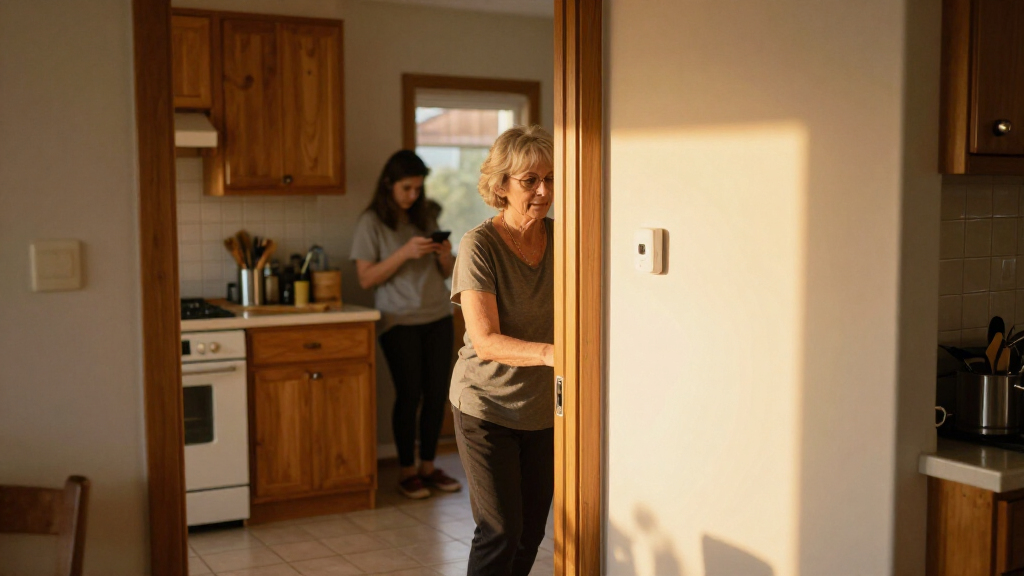
For older people who want to remain at home, a monitoring system that does not require a camera or wearable could offer another way for caregivers to notice unusual activity. The researchers say alerts could prompt care professionals or relatives to check on a resident remotely or in person when the system detects a possible emergency.
The work also points to a potential role beyond acute incidents. The team says changes in mobility, sleep patterns, inactivity or ordinary household routines could help flag possible deterioration. Those are potential indicators, not diagnoses: the study describes a system for recognizing activity patterns, not a clinical tool shown to identify specific illnesses reliably. Whether it can help someone remain at home longer will depend on further testing and on how alerts are handled in practice.
elderly home activity monitoring system
As an affiliate, we earn on qualifying purchases.
As an affiliate, we earn on qualifying purchases.
How the Prototype Combines Sensors
The research, titled Privacy-Preserving Ambient Sensing for Activities of Daily Living: Multimodal Radar–Thermal Human Activity Recognition and Smart Plug Appliance Recognition, was published in Sensors in 2026. The listed researchers include Dr. Yangang Xing and colleagues at NTU, along with Dr. Geoff Archenhold, Bilal Mohammed and Martin Harris of Integrated System Technologies Ltd.
The approach combines three kinds of signals rather than relying on a single sensor. Radar tracks movement; thermal sensing estimates posture; and smart plugs provide information about appliance use. The researchers’ stated aim is to build a picture of daily activity while limiting the capture of personal visual detail. Their test in a mock home offers an initial assessment of the combined setup, rather than evidence from long-term monitoring of older residents.
“This technology aims to support the growing number of older adults who wish to remain in their own homes for longer, rather than moving into residential care.”
— Dr. Yangang Xing, lead researcher at NTU
As an affiliate, we earn on qualifying purchases.
Real-Home Performance Still Unknown
The reported testing took place in a mock domestic environment, not as long-term monitoring in occupied homes. The supplied study summary does not give detailed accuracy figures, false-alarm rates, the number of participants, or results for detecting particular medical emergencies. It therefore does not show how reliably the system would identify falls, strokes, heart attacks or other critical illnesses in everyday use.
It is also not clear from the report how well the system would adapt to different residents, home layouts or changes in appliance use, or how data would be stored and protected. The researchers describe privacy-conscious sensor design, but the available information does not specify a product launch, regulatory status, cost to households or timetable for wider trials. The system should not be presented as a substitute for emergency services, professional care or medical assessment.
As an affiliate, we earn on qualifying purchases.
Further Testing Needed Before Use
The study’s findings provide a basis for further development, but the report does not announce a next trial date or a commercial release. Before practical use can be assessed, researchers would need to test the system with residents in real homes over time and report how accurately it recognizes routine activity and unusual events, including how often it misses events or raises unnecessary alerts.
Further work would also need to clarify how caregivers receive and respond to alerts, how consent and privacy are managed, and whether the system is affordable and useful to older people and care providers. For now, the confirmed result is limited to improved performance when the three sensor types were combined in the team’s mock-home testing.
As an affiliate, we earn on qualifying purchases.
Key Questions
What does the home sensor system use?
It combines millimeter-wave radar for movement, low-resolution thermal sensors for posture and smart plugs that track use of connected appliances.
Has it been tested in older people’s homes?
The reported study tested the prototype in a mock domestic environment with six room layouts. The supplied report does not describe long-term testing in occupied homes.
Can the system diagnose a fall, stroke or heart attack?
The researchers say the system is intended to flag possible emergencies or unusual behavior. The reported testing does not establish that it can diagnose or reliably detect specific medical conditions.
How does the system aim to protect privacy?
It does not use cameras or wearable devices. The thermal output is described as highly pixelated and low resolution, while radar and appliance-use data contribute to activity monitoring.
When will the system be available?
The report does not give a release date, price or timetable for wider trials. Its reported evidence comes from prototype testing in a mock home.
Source: rss
Halloween Picks
halloween
As an affiliate, we earn on qualifying purchases.