TL;DR

Get comfort and care essentials delivered free — and shop member deals
- Fast, free delivery on millions of items
- Access to Prime Big Deal Days deals on October 6–7
- Prime Video, Amazon Music and more included
A Sixty and Me report outlines five simple, mostly equipment-free exercises intended to support movements used in daily life, including standing from a chair, reaching and keeping balance. It cites research and public-health guidance on activity for older adults, while advising readers with health concerns to consult a health professional before starting.
Sixty and Me has published a beginner’s guide to functional fitness for women over 60, describing five simple exercises that can be done at home with little or no equipment. The report focuses on practical movements such as rising from a chair, pushing, stepping sideways and practicing balance, linking them to everyday tasks and independence.
The guide defines functional fitness as training that helps people perform daily activities. It points to movements such as squatting to pick something up, pushing an object and reaching overhead as examples of tasks that exercise can help prepare people to do. Unlike a program organized only around general strength or endurance, this approach connects exercise with familiar actions at home and elsewhere.
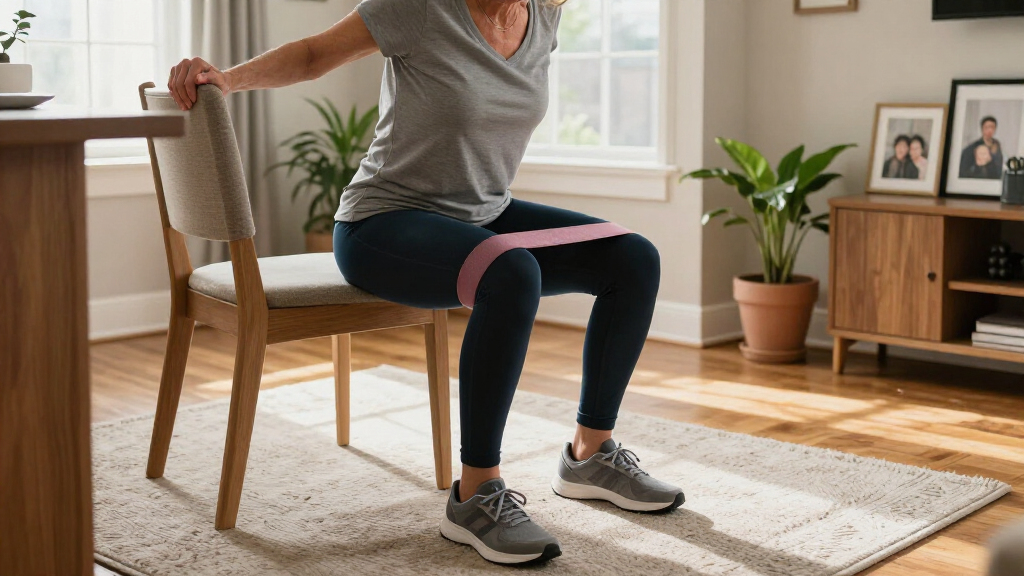
The five suggested exercises are sit-to-stands, wall push-ups, supported heel raises, supported side steps and supported balance practice. The guide recommends 5–12 repetitions for the first three. For sit-to-stands, it instructs readers to sit toward the front of a chair, lean slightly forward and stand using their legs before lowering back down. Wall push-ups are done with hands against a wall; heel raises use a chair behind the exerciser for support.
For side steps and balance practice, the report advises using a counter or chair if support is needed. It says to step in both directions for the side-step exercise and to shift weight from one leg to the other for balance practice, lifting a leg only if comfortable. A stable surface should be within reach during balance exercises.
Exercises Linked to Daily Tasks
The guide’s central point is that strength, mobility and balance can affect routine activities, from carrying groceries to getting up from a chair. Practicing movements similar to those tasks may give older adults a way to work on physical abilities in a familiar setting. The report frames this as support for quality of life and independence, not as a guarantee that exercise will prevent disability or falls.
It cites a 2025 meta-analysis that, according to the article, found functional task training helped improve balance, mobility and walking ability among adults aged 60 and older. The source material does not provide the study title, authors, number of participants or size of the reported effects, so readers cannot assess those details from the guide alone. It also refers to a review of studies that found a combination of balance and functional training may help prevent falls and improve physical well-being in older adults.
The practical relevance is that the suggested routine requires little equipment and can be adjusted to the person’s comfort. Still, the exercises are examples rather than a personalized plan, and the report does not claim they are appropriate for every health condition or ability level.
As an affiliate, we earn on qualifying purchases.
Activity Guidance for Older Adults
The report places its exercise suggestions alongside public-health recommendations. It says the U.S. Centers for Disease Control and Prevention recommends that adults aged 65 and older do muscle-strengthening activities at least twice a week, along with activity that supports cardiovascular and pulmonary health and balance. It also cites the World Health Organization as recommending muscle-strengthening activity on two days a week for adults aged 65 and older.
According to the guide, WHO suggests balance and fall-prevention activities on three or more days a week for people with mobility difficulties. The recommendations are general guidance, not a prescription for a specific set of exercises. The article proposes beginning with 10–15 minutes on two or three days in a week, then gradually adding time, repetitions or a resistance band as exercises become easier.
The report also suggests incorporating movement into ordinary routines, such as walking regularly or using stairs when appropriate. Its broader premise is that exercise can be made relevant to valued daily activities, rather than treated only as a separate workout.
““The goal of functional fitness is to help you maintain your quality of life and your independence.””
— Sixty and Me report
As an affiliate, we earn on qualifying purchases.
Individual Needs and Evidence Details
The supplied report does not give a publication date, identify the 2025 meta-analysis or review by title, or describe their methods and effect sizes. The evidence cited is therefore summarized rather than independently detailed in the article. It is also unclear whether the five exercises were tested together as a program; the report presents them as beginner options, not as a clinically validated routine.
People differ in mobility, balance, pain and health conditions. The guide does not establish that each exercise is safe or suitable for every woman over 60, nor does it promise that the routine will prevent falls. It advises consulting a health care professional when limitations, pain, dizziness or other concerns are present, and stopping an activity if something feels wrong.
As an affiliate, we earn on qualifying purchases.
Starting With a Manageable Routine
The guide recommends setting a realistic initial plan: try 10–15 minutes of functional exercises on two or three days in the coming week, choosing activities that feel enjoyable and manageable. If they become easier, readers can increase duration or repetitions, or add a resistance band. The report advises making changes gradually rather than treating the suggested numbers as a requirement for everyone.
For anyone with health-related limitations or uncertainty about balance, pain or dizziness, the next step is to discuss activity with a qualified health professional. During exercise, a sturdy counter or chair can provide support for balance work, and the guide says to stop if an activity does not feel right. The source does not announce a follow-up study or program; it offers practical suggestions for readers to adapt to their own circumstances.
As an affiliate, we earn on qualifying purchases.
Key Questions
What does functional fitness mean in this guide?
It means practicing strength, mobility and balance through movements related to daily tasks, such as standing from a chair, reaching or stepping sideways.
Which exercises does the report suggest?
The five examples are sit-to-stands, wall push-ups, supported heel raises, supported side steps and supported balance practice. A chair, wall or counter can provide support, and the report says little or no equipment is needed.
How often does the guide suggest starting?
It proposes trying 10–15 minutes on two or three days in a week, then gradually increasing time or repetitions if the movements become easier. This is the report’s starter suggestion, not an individualized prescription.
Should someone with pain or balance concerns try these exercises?
The guide advises speaking with a health care professional if a person has a health condition, mobility limitation, pain, dizziness or other concerns. It also says to keep a sturdy support nearby for balance practice and stop if an activity feels wrong.
Source: rss
Cold & flu season Picks
humidifiers
As an affiliate, we earn on qualifying purchases.