Automatic pill dispensers for seniors can help organize a complex medication schedule, but the right choice depends on how much help a person needs and who will manage setup. I rank the Live Fine Automatic Locking Pill Dispenser, 28-Day, Frosted Lid as the best overall for its combination of locking access and long capacity. The Med-Q Electronic Pill Dispenser is a stronger fit when straightforward reminders are the priority, while the 21-Day Wi-Fi model with rising pods stands out for caregiver monitoring. The main tradeoffs are capacity versus ease of refilling, simple alarms versus connected features, and medication access versus added protection. Read on for the full breakdown, ranking logic, and advice for matching a dispenser to a senior’s routine.

Turn quiet afternoons into listening time
- Thousands of audiobooks, podcasts and originals
- Listen on your phone, tablet or Echo — also offline
- Cancel anytime
Complete the kit


Key Takeaways
- Locking access is a leading differentiator: several 28-day models, including the Live Fine and EziMedPil options, limit access to the scheduled dose, while simpler alarm models may offer less control over extra handling.
- Long capacity can reduce refill work but not daily setup needs: 42-day and 31-slot designs offer more room, yet buyers still need to confirm that their medication schedule fits the compartment layout.
- Connected features serve a different buyer: the Wi-Fi, Bluetooth, and app-controlled models make more sense when a caregiver will use remote tools; they add setup and phone dependence that some households do not need.
- Physical access matters as much as alerts: slide doors, rising pods, removable cups, and front-facing locks change how easily a user can retrieve a dose, so dexterity and vision should guide the choice.
- The lineup favors distinct needs rather than one feature set: Live Fine’s 28-day locking design leads for broad use, Med-Q suits buyers seeking a simpler electronic reminder, and the Wi-Fi model targets families who want remote oversight.
| Live Fine Automatic Locking Pill Dispenser, 28-Day, Frosted Lid |  | Best for Complex Schedules | Capacity: 28 days | Maximum doses per day: 9 | Dosage rings: 9 interchangeable | VIEW LATEST PRICE | See Our Full Breakdown |
| Med-Q Electronic Pill Dispenser with Alarm for Dementia and Elderly |  | Best for Simple Morning-and-Evening Routines | Size: 8.75 × 4.5 × 1 inches | Power source: 2 AA batteries, not included | Battery life: Approximately 14 months | VIEW LATEST PRICE | See Our Full Breakdown |
| 28-Day Automatic Pill Dispenser with Slide-Door Cup and Sound & Light Alerts |  | Best for Cup-Based Dispensing | Capacity: 28 compartments | Dispensing: One-press slide-door release into a cup | Alerts: Sound, light, or sound and light | VIEW LATEST PRICE | See Our Full Breakdown |
| Colorwing Smart Pill Dispenser with 31 Slots, Bluetooth Reminders, and Dual Locks |  | Best for Fingerprint Access | Capacity: 31 slots | Access: Palm-activated press-release picker box | Security: Fingerprint scanner and mechanical backup key | VIEW LATEST PRICE | See Our Full Breakdown |
| 28-Day Automatic Pill Dispenser with Expandable 2-Tray Design, App Control, LCD Display, Digital Lock, and Alerts |  | Best for Remote Caregiver Oversight | Capacity: 2 trays, 14 slots per tray | Dosing capacity: Up to 28 days once daily or 14 days twice daily | Setup: Mobile app or on-device buttons with voice guidance | VIEW LATEST PRICE | See Our Full Breakdown |
| Automatic Pill Dispenser with Alarm for Seniors |  | Best for Simple, Accessible Daily Dosing | Compartments: 28 | Daily reminders: 1 to 6 | Alerts: Loud alarm and flashing blue light | VIEW LATEST PRICE | See Our Full Breakdown |
| Automatic Pill Dispenser with Alarm, 28 Compartments |  | Best for Flexible Pickup Schedules | Compartments: 28 | Maximum daily reminders: 6 | Pickup modes: Free, fixed time, and flexible window | VIEW LATEST PRICE | See Our Full Breakdown |
| 21-Day Wi-Fi Automatic Pill Dispenser with Rising Pods and Remote Monitoring |  | Best for Caregiver Remote Monitoring | Capacity: Up to 21 days | Dose rings and alarms: 8 dose rings and 8 alarms | Pod capacity: Up to 12 capsules or softgels per pod | VIEW LATEST PRICE | See Our Full Breakdown |
| Automatic Pill Dispenser with Alarm for Seniors |  | Best for Familiar, Battery-Ready Operation | Compartments: 28 | Daily reminders: 1 to 6 times | Dosage rings: 6 | VIEW LATEST PRICE | See Our Full Breakdown |
| EziMedPil 28-Day Locked Automatic Pill Dispenser with Frosted Privacy Lid |  | Best for High-Capacity Locked Storage | Compartments: 28 | Capacity per compartment: Up to 24 aspirin-sized tablets | Total capacity: 672 pills | VIEW LATEST PRICE | See Our Full Breakdown |
| LiveFine Automatic Pill Dispenser with Removable Cups, 21 Compartments, 9 Dosage Rings, Alarm, LCD Display, and Locking Key |  | Best for Easier Pill Retrieval | Compartments: 21 | Dosage rings: 9 interchangeable rings for 1–9 doses daily | Alert pattern: Visual and audible alerts every 7 seconds for up to 30 minutes | VIEW LATEST PRICE | See Our Full Breakdown |
| Automatic Pill Dispenser with 9 Alarms & Front Key Lock for Seniors |  | Best for Simple, App-Free Setup | Alarms: Up to 9 customizable alerts | Alert types: Sound and flashing light | Sound options: 3 volume levels and 3 built-in tones | VIEW LATEST PRICE | See Our Full Breakdown |
| 42-Day Automatic Pill Dispenser with App Setup, LCD Display, Digital Lock, and Alerts, 3-Tray, White |  | Best for Longer Refill Intervals | Capacity: 3 trays with 14 slots each | Stated dosing duration: Up to 42 days at once-daily dosing | Setup: On-device buttons with voice prompts or companion app | VIEW LATEST PRICE | See Our Full Breakdown |
| Betife 28-Day Automatic Pill Dispenser with Bluetooth and App Control |  | Best for Caregiver Dose Tracking | Capacity: 28 days | Connectivity: Bluetooth | Companion app: Pillcalendar | VIEW LATEST PRICE | See Our Full Breakdown |
| LiveFine Automatic Pill Dispenser, 28-Day Capacity with Locking Lid |  | Best for a Large, Easy-to-Read Display | Capacity: Up to 28 days | Doses per day: Up to 9 | Pills per slot: Up to 18 | VIEW LATEST PRICE | See Our Full Breakdown |
| automatic pill dispensers for senior | Alerts | Display | Capacity |
|---|---|---|---|
| Live Fine Automatic Locking Pi | Adjustable audio and visual reminders, up to 30 minutes | Jumbo LCD | 28 days |
| Med-Q Electronic Pill Dispense | — | — | — |
| 28-Day Automatic Pill Dispense | Sound, light, or sound and light | — | 28 compartments |
| Colorwing Smart Pill Dispenser | — | — | 31 slots |
| 28-Day Automatic Pill Dispense | LED light, voice, buzzer, or melody | LCD | 2 trays, 14 slots per tray |
| Automatic Pill Dispenser with | Loud alarm and flashing blue light | LCD | — |
| Automatic Pill Dispenser with | Audible alarm and flashing light | LCD with time, alarm settings, mode, and low-battery indicator | — |
| 21-Day Wi-Fi Automatic Pill Di | Loud alarm, flashing light, and low-battery alert | — | Up to 21 days |
| Automatic Pill Dispenser with | Loud alarm and flashing blue light | LCD | — |
| EziMedPil 28-Day Locked Automa | Audible and visual | Large high-brightness LCD | — |
| LiveFine Automatic Pill Dispen | — | LCD with 12/24-hour formats and low-battery indicator | — |
| Automatic Pill Dispenser with | — | — | — |
| 42-Day Automatic Pill Dispense | — | LCD | 3 trays with 14 slots each |
| Betife 28-Day Automatic Pill D | — | — | 28 days |
| LiveFine Automatic Pill Dispen | Audio and visual | Jumbo LCD | Up to 28 days |
More Details on Our Top Picks
Live Fine Automatic Locking Pill Dispenser, 28-Day, Frosted Lid
The Live Fine 28-Day dispenser is the strongest fit here for seniors managing several daily medication times: its carousel holds up to 28 days and supports up to nine doses per day. Interchangeable dosage rings help match the schedule, while the jumbo LCD and adjustable audio and visual reminders make the next dose easier to track. Compared with the Med-Q Electronic Pill Dispenser, it offers far more scheduling capacity and a locking cover, but requires more setup through button controls. The sliding retrieval window limits access to the dose at hand, while the manual key adds security at the cost of another item a caregiver must keep available. Its frosted lid also gives the stored medication some privacy.
Pros:- Stores up to 28 days of medication and supports up to nine doses per day.
- Interchangeable dosage rings help configure different schedules.
- Jumbo LCD and adjustable audio and visual reminders support dose awareness.
- Locking cover and sliding retrieval window limit access to stored medication.
Cons:- Programming relies on button controls and may take more effort than app-guided setup.
- The manual key must be available when access to stored medication is needed.
Best for: Seniors with multiple medication times each day who need a large display, configurable reminders, and restricted access to stored doses.
Not ideal for: People who need app-based setup or cannot reliably manage button programming and a separate manual key.
- Capacity:28 days
- Maximum doses per day:9
- Dosage rings:9 interchangeable
- Alerts:Adjustable audio and visual reminders, up to 30 minutes
- Display:Jumbo LCD
- Cover:Lockable, with manual key
- Retrieval:Sliding window
- Lid:Frosted
Our verdict“Choose this model for a complex daily schedule and lockable storage, provided someone can handle its button-based setup and keep track of the key.”
Med-Q Electronic Pill Dispenser with Alarm for Dementia and Elderly
The Med-Q favors clear prompts over long-term capacity or advanced scheduling. Its 14 labeled compartments divide a week into morning and evening doses, and the flashing light identifies the specific box to open. Repeat alarms every 30 minutes continue until acknowledged, which may help a senior who misses an initial reminder. Compared with the Live Fine 28-Day dispenser, Med-Q is simpler to read and uses easy-flip lids, but it holds only seven days and does not lock. Each compartment fits about seven large pills, so a regimen with bulky tablets may outgrow it. Two AA batteries are not included, though the stated battery life of about 14 months means replacements should be infrequent.
Pros:- Flashing light and audible alarm identify when a dose is due.
- Highlights the specific compartment to open, reducing guesswork.
- Large day labels and easy-flip lids support straightforward access.
- Runs on two AA batteries with an approximate 14-month battery life and a low-battery indicator.
Cons:- Compartments do not lock, so stored pills remain accessible.
- Supports only one or two alarms per day and holds a one-week supply.
- AA batteries are not included, and capacity is limited to about seven large pills per compartment.
Best for: Seniors who take medication once or twice daily and benefit from a flashing prompt that points to the correct day-and-time compartment.
Not ideal for: People who need locked medication storage, more than two daily dose times, or space for many large pills in each compartment.
- Size:8.75 × 4.5 × 1 inches
- Power source:2 AA batteries, not included
- Battery life:Approximately 14 months
- Compartments:14: 7 days with morning and evening compartments
- Pills per compartment:Up to about 7 large pills
- Alarms per day:1 or 2
- Reminder behavior:Audible alarm and flashing light; repeats every 30 minutes until acknowledged
Our verdict“Pick Med-Q for a clearly marked, twice-daily weekly routine, but skip it if locking or a longer supply is a priority.”
28-Day Automatic Pill Dispenser with Slide-Door Cup and Sound & Light Alerts
This 28-compartment model is differentiated by its one-press slide-door release into a cup, a helpful format for someone who would rather collect a dose than pick pills from a compartment. Sound, light, or combined alerts let a household choose a prompt style, and the sealed lid, silicone seal, and dual desiccant slots add moisture protection. Compared with the Live Fine 28-Day dispenser, this design puts more emphasis on cup dispensing and humidity safeguards than on a large LCD, lockable cover, or a stated high number of daily doses. Its fit examples cover several common tablet and capsule sizes, but gummy-style capsules may stick. It is intended for home use, not regulated care facilities, and does not accept add-on trays.
Pros:- Releases medication into a cup through a one-press slide-door mechanism.
- Offers sound-only, light-only, or combined alerts.
- Water-resistant lid, silicone seal, and dual desiccant slots help limit moisture exposure.
- Pill-fit examples include common calcium tablets, vitamins, and capsules.
Cons:- Gummy-style capsules may stick in the dispenser.
- Add-on trays are not supported, limiting expansion.
- Not intended for assisted living, nursing homes, or other regulated care settings.
Best for: Home users who prefer collecting each dose in a cup and want selectable sound or light reminders with added moisture protection.
Not ideal for: Care facilities, households needing expandable trays, or seniors whose medication includes gummy-style capsules.
- Capacity:28 compartments
- Dispensing:One-press slide-door release into a cup
- Alerts:Sound, light, or sound and light
- Moisture protection:Water-resistant lid, silicone seal, and dual desiccant slots
- Humidity protection claim:Maintains pill stability in high humidity for 7+ days
- Pill-fit examples:Calcium tablets (0.79 in) × 16; vitamins (0.31 in) × 14; capsules (0.75 in) × 13
- Add-on trays:Not supported
- Intended use:Home and non-institutional use
Our verdict“Choose this model for home dosing into a cup and moisture-conscious storage, not for gummy capsules or institutional care.”
Colorwing Smart Pill Dispenser with 31 Slots, Bluetooth Reminders, and Dual Locks
The Colorwing Smart Pill Dispenser pairs a palm-activated picker box with a fingerprint scanner, making it a distinct option for seniors who struggle with small controls or need restricted medication access. A mechanical backup key provides another way to open it, and reminders can use a custom voice recording or one of three tones. Its Bluetooth 5.0 app support adds scheduling assistance, while the listed 30+ days of battery life in energy-smart mode can reduce charging frequency. Compared with the 28-Day Automatic Pill Dispenser with Expandable 2-Tray Design, Colorwing offers fingerprint access and a stated 31-slot capacity, but the other model includes voice-guided on-device setup and app dose history. Colorwing requires a phone for app features and periodic recharging, so it suits a digitally supported routine better than a fully standalone one.
Pros:- Palm-activated press-release picker box is designed for easier access.
- Fingerprint scanner and mechanical backup key offer two access methods.
- Supports custom voice recordings or three alert tones.
- Rechargeable battery and Bluetooth app support add scheduling options.
Cons:- App features require a Bluetooth connection to a phone.
- Rechargeable battery requires periodic charging.
- Fingerprint access may be less convenient if the scanner does not recognize a user’s print.
Best for: Seniors with arthritis or caregivers seeking fingerprint-controlled access, custom voice reminders, and Bluetooth scheduling support.
Not ideal for: People without a compatible phone, anyone who prefers disposable batteries, or users who want app-free dose tracking.
- Capacity:31 slots
- Access:Palm-activated press-release picker box
- Security:Fingerprint scanner and mechanical backup key
- Dose rings:7 reversible rings
- Reminders:Custom voice recording or 3 alert tones
- Connectivity:Bluetooth 5.0 with companion app
- Battery:1200 mAh rechargeable; listed 30+ days in energy-smart mode
- Charging time:2 hours
Our verdict“Choose Colorwing when fingerprint access and phone-supported reminders matter more than app-free operation or avoiding charging.”
28-Day Automatic Pill Dispenser with Expandable 2-Tray Design, App Control, LCD Display, Digital Lock, and Alerts
This two-tray dispenser is the most caregiver-oriented option in this group: its app supports dose history, remote settings, and missed-dose alerts, while setup can also be done on the device with voice guidance. The 28 slots cover up to 28 days for once-daily dosing or 14 days for twice-daily dosing, so the same capacity translates differently depending on the regimen. Compared with the Colorwing Smart Pill Dispenser, it offers app dose-history checks and an on-device setup alternative, while Colorwing adds fingerprint access and a palm-activated picker. A digital lock, LED, voice, buzzer, or melody alerts, and a sealed lid with desiccant broaden its home-use features. It is not intended for regulated care facilities, and app access may add setup work for caregivers.
Pros:- App supports dose history, remote settings, and missed-dose alerts.
- Scheduling can be entered through the app or on-device buttons with voice guidance.
- Multiple reminder styles include LED light, voice, buzzer, and melody.
- Digital lock and sealed lid with built-in desiccant add access control and moisture protection.
Cons:- Not intended for assisted living, nursing homes, or other regulated institutions.
- The 28 slots provide only 14 days of storage for twice-daily dosing.
- Remote features depend on app setup and caregiver access to a phone.
Best for: Families caring for a senior at home who want remote dose-history checks and missed-dose notifications, with the option to set schedules on the device.
Not ideal for: Regulated care settings or people who need a month of medication at more than one dose per day.
- Capacity:2 trays, 14 slots per tray
- Dosing capacity:Up to 28 days once daily or 14 days twice daily
- Setup:Mobile app or on-device buttons with voice guidance
- Display:LCD
- Alerts:LED light, voice, buzzer, or melody
- Security:Digital lock; lid can be locked or unlocked through the app
- Storage:Sealed lid and built-in desiccant pack
- Intended use:Home and non-institutional use
Our verdict“Pick this dispenser for home-based caregiver oversight and flexible setup, but match its tray capacity to the user’s daily dose frequency.”
Automatic Pill Dispenser with Alarm for Seniors
For seniors who need familiar reminders rather than app-based oversight, this model pairs a 28-compartment tray with audio and visual alerts for up to six daily doses. Its sliding retrieval window and access-oriented lid can make reaching the scheduled dose easier, while the removable tray helps caregivers refill and check the organizer. Compared with the Wi-Fi-enabled 21-Day model, this dispenser skips remote monitoring and rising pods, but also avoids app setup and connected features. The tradeoff is that its reminder flexibility is limited to the listed one-to-six-times-daily schedule, and it runs on four AA batteries. The supplied information lists batteries among the accessories, though the battery-inclusion details are not fully consistent, so buyers should confirm package contents before relying on them.
Pros:- 28 compartments can reduce how often caregivers need to refill it.
- Audio alarm and flashing blue light provide two reminder cues.
- Sliding retrieval window and access-oriented lid support easier dose pickup.
- Removable tray and transparent lid help with refilling and checking doses.
Cons:- Requires four AA batteries, so the unit depends on periodic battery replacement.
- No app or remote monitoring is listed for caregiver oversight.
- Battery inclusion is unclear in the supplied details despite batteries appearing in the accessory list.
Best for: Seniors who want straightforward audio and visual dose reminders, plus a removable tray that a caregiver can refill.
Not ideal for: Caregivers who need remote confirmation of doses or seniors whose medication schedule requires unscheduled access.
- Compartments:28
- Daily reminders:1 to 6
- Alerts:Loud alarm and flashing blue light
- Display:LCD
- Tray:Removable; food-grade materials
- Dosage rings:6
- Power:4 AA batteries; inclusion details are unclear
- Included accessories:3 black keys and instruction manual
Our verdict“Choose this for a familiar, removable-tray setup with multiple daily alerts, but skip it if caregiver app monitoring is a priority.”
Automatic Pill Dispenser with Alarm, 28 Compartments
The standout here is not its capacity—shared with several options in this group—but its three pickup modes. Free, fixed-time, and flexible-window pickup give households more control over when a dose can be retrieved; the flexible setting allows access up to an hour before or after an alarm. That can suit routines where exact pickup times are difficult, unlike the more straightforward one-to-six-reminder approach of the B0BL2BJ24F dispenser. A key-locked cover and desiccant slots add storage protections, while the LCD shows the selected mode and low-battery status. The tradeoff is practical: four AAA batteries are not included, and the unit is not rechargeable. I would favor this model for someone who benefits from a defined pickup window, not for a household seeking app-based caregiver tracking like the Wi-Fi 21-Day dispenser.
Pros:- Free, fixed-time, and flexible-window modes accommodate different routines.
- Flexible pickup can allow access up to one hour before or after an alarm.
- LCD displays time, alarm settings, mode, and low-battery status.
- Key-locked cover and desiccant slots help protect stored medication.
Cons:- Four AAA batteries are required and are not included.
- Battery power is not rechargeable, so the user must replace batteries.
- No Wi-Fi or caregiver app monitoring is listed.
Best for: Seniors with variable daily routines who need a controlled pickup window and caregivers who want to choose among dispensing modes.
Not ideal for: People who want rechargeable power, included batteries, or remote app monitoring of medication progress.
- Compartments:28
- Maximum daily reminders:6
- Pickup modes:Free, fixed time, and flexible window
- Flexible pickup window:Up to 1 hour before or after an alarm
- Power:4 AAA batteries; not included; not rechargeable
- Display:LCD with time, alarm settings, mode, and low-battery indicator
- Access:Key-locked cover
- Alerts:Audible alarm and flashing light
Our verdict“Pick this model when adjustable dose pickup matters more than rechargeable power or remote caregiver tracking.”
21-Day Wi-Fi Automatic Pill Dispenser with Rising Pods and Remote Monitoring
Caregiver visibility sets this apart from the non-connected 28-compartment dispensers in this batch. Its Wi-Fi app supports remote monitoring, reminders, settings changes, and 14-day medication records, giving family members more information than the LCD and local alerts on the B0BZ4KJFFV. The rising pods also bring doses up for access rather than asking the user to lift or tip the dispenser, a useful distinction for limited reach or grip. Capacity is up to 21 days, shorter than the 28-compartment options, and each pod holds up to 12 capsules or softgels. App features depend on Wi-Fi and setup, while scheduled controlled dispensing may not suit routines that require unscheduled access. Its plug-in or battery operation adds placement flexibility, but this is the most connected—and setup-dependent—choice here.
Pros:- App supports remote monitoring, reminders, setting adjustments, and 14-day medication records.
- Rising pods make doses easier to reach without lifting or tipping the dispenser.
- Removable washable tray supports filling and cleaning.
- Plug-in or battery operation, plus a low-battery alert, gives flexible power options.
Cons:- Remote features require Wi-Fi and app setup.
- Up to 21 days of capacity is less than the 28 compartments offered by several alternatives here.
- Scheduled controlled dispensing may not work for medication routines requiring unscheduled access.
Best for: Families supporting a senior remotely who want app-based reminders, medication records, and easier-to-reach rising pods.
Not ideal for: Seniors without reliable Wi-Fi or app support, or anyone whose medication plan requires unscheduled access to stored doses.
- Capacity:Up to 21 days
- Dose rings and alarms:8 dose rings and 8 alarms
- Pod capacity:Up to 12 capsules or softgels per pod
- Connectivity:Wi-Fi with app
- App features:Remote monitoring, reminders, settings adjustment, and 14-day medication records
- Alerts:Loud alarm, flashing light, and low-battery alert
- Power:Plug-in or battery
- Tray:Removable and washable
- Included accessories:Key, instruction manual, batteries, charger with cable, and 3 backup pods
Our verdict“Choose this when remote caregiver oversight and rising-dose access outweigh the shorter capacity and Wi-Fi setup.”
Automatic Pill Dispenser with Alarm for Seniors
This model is a straightforward choice for households that want six dosage rings, a removable 28-compartment tray, and clear local alerts without connected features. Its loud alarm and flashing blue light provide two ways to signal dose time, while the LCD gives users a display for setup and routine checks. Compared with the B0H7GSGB14, it does not offer free, fixed, and flexible pickup modes; its appeal is a simpler reminder-centered setup, with four AA batteries listed as included. That detail also gives it a practical advantage over dispensers that require buyers to source batteries separately. The tradeoff is that it must be programmed before use, and the supplied information does not describe remote monitoring or more flexible access windows. I’d choose it for a regular, planned medication schedule rather than a changing routine.
Pros:- 28 compartments can reduce refill frequency.
- Loud alarm and flashing blue light provide audio and visual reminders.
- Removable tray and sliding retrieval window support access and monitoring.
- Four AA batteries are listed as included.
Cons:- Must be programmed before use, which may require caregiver help.
- No app-based remote monitoring or caregiver progress records are listed.
- No adjustable pickup-window modes are specified.
Best for: Seniors with a consistent medication schedule who want local sound-and-light reminders and a removable tray, with batteries listed in the package.
Not ideal for: Caregivers who need remote dose tracking or users who need a flexible pickup window around alarm times.
- Compartments:28
- Daily reminders:1 to 6 times
- Dosage rings:6
- Alerts:Loud alarm and flashing blue light
- Display:LCD
- Tray material:Food-grade materials
- Power:4 AA batteries included
- Included:Dispenser, 6 dosage rings, instruction manual, and 4 AA batteries
Our verdict“Choose this for a planned daily routine and included battery power, but look elsewhere for flexible pickup or remote monitoring.”
EziMedPil 28-Day Locked Automatic Pill Dispenser with Frosted Privacy Lid
EziMedPil is the strongest fit here for buyers who prioritize locked access and high compartment capacity. Its 28 compartments hold up to 24 aspirin-sized tablets each, with a stated total capacity of 672 pills, and six interchangeable dosage rings adapt the layout to different schedules. The frosted privacy lid helps shield medication and restrict access, while a built-in magnifier, bright LCD, and anti-slip grips address vision and hand-strength needs. Compared with the Wi-Fi 21-Day model, EziMedPil offers more compartments and no app setup, but it lacks listed remote monitoring and rising pods. Its substantial capacity comes with tradeoffs: initial alarm programming can take time, four AA batteries need periodic replacement, and the unit may be bulky for travel or a small bedside area. It suits controlled home routines better than frequent portability.
Pros:- 28 compartments hold up to 24 aspirin-sized tablets each, with stated total capacity of 672 pills.
- Frosted lockable lid helps limit unauthorized access and shield medication.
- Built-in magnifier, bright LCD, and anti-slip grips support users with vision or hand-strength limitations.
- Six interchangeable dosage rings accommodate different dosing layouts.
Cons:- The dispenser may be bulky for travel or small living spaces.
- Alarm setup can take time for users who need several daily schedules.
- Four AA batteries require periodic replacement.
Best for: Seniors or caregivers who need a lockable, high-capacity home dispenser with visual aids and interchangeable dosing layouts.
Not ideal for: Frequent travelers, people with limited storage space, or caregivers who need remote app monitoring.
- Compartments:28
- Capacity per compartment:Up to 24 aspirin-sized tablets
- Total capacity:672 pills
- Dosage rings:6 interchangeable
- Power:4 AA batteries included
- Alerts:Audible and visual
- Display:Large high-brightness LCD
- Lid:Lockable frosted privacy lid
Our verdict“Choose EziMedPil for locked, high-capacity home storage and built-in visual aids, but skip it if portability or remote oversight leads your priorities.”
LiveFine Automatic Pill Dispenser with Removable Cups, 21 Compartments, 9 Dosage Rings, Alarm, LCD Display, and Locking Key
The removable, extending cup is the main reason I’d choose this LiveFine for someone who finds it difficult to reach into a standard dispenser. It also lets a caregiver refill the 21 compartments away from the device, while nine interchangeable rings accommodate schedules of up to nine doses a day. Visual and audible reminders continue every seven seconds for up to 30 minutes, so the alerts may be hard to miss—but potentially intrusive in a quiet home. Compared with the LiveFine 28-Day Capacity with Locking Lid, this model trades longer stated capacity for a more accessible cup and a clear low-battery display. It runs on four AA batteries rather than household power, and the locking key helps limit unwanted access. I’d pick it for easier handling, not for a quieter alert routine.
Pros:- Removable cup extends for easier pill access.
- Compartments can be refilled away from the dispenser.
- Visual and audible reminders support dose awareness.
- Locking key helps prevent tampering.
Cons:- Four AA batteries need periodic replacement.
- Alerts repeat every seven seconds for up to 30 minutes, which may be disruptive.
Best for: Seniors with limited reach or dexterity who benefit from a cup that extends for pill retrieval, especially when a caregiver fills the compartments.
Not ideal for: People who are bothered by frequent repeating alarms or want a dispenser with capacity beyond 21 compartments.
- Compartments:21
- Dosage rings:9 interchangeable rings for 1–9 doses daily
- Alert pattern:Visual and audible alerts every 7 seconds for up to 30 minutes
- Display:LCD with 12/24-hour formats and low-battery indicator
- Volume levels:3
- Power:4 AA batteries, included
- Security and access:Locking key and removable cups
Our verdict“Choose this LiveFine if an extending, removable cup matters more than a quieter alarm or longer capacity.”
Automatic Pill Dispenser with 9 Alarms & Front Key Lock for Seniors
This dispenser suits seniors and caregivers who want straightforward scheduling without a phone, app, or wireless connection. Its four-button setup, nine customizable alarms, and flashing-light and sound alerts keep the process focused on the dispenser itself. The front-mounted key lock secures both the compartments and battery cover, while the transparent lid lets a caregiver check the contents without opening it. Compared with the Betife 28-Day Automatic Pill Dispenser, this model favors simple standalone operation over phone notifications and dose-tracking statistics. It also includes three tones and three volume levels, giving some choice over alerts. The tradeoff is that it still relies on AA batteries, and the included nine dosage rings may not fit every medication routine. I’d choose it for uncomplicated home use, rather than for families who want remote monitoring.
Pros:- Four-button setup works without an app or wireless connection.
- Up to nine customizable alarms combine sound and flashing light.
- Front key lock secures compartments and the battery cover.
- Includes three tones, three volume levels, and a low-battery indicator.
Cons:- Requires four AA batteries and periodic replacement.
- Nine dosage rings may not suit more complex schedules.
Best for: Seniors who prefer physical controls and caregivers who want a locked, app-free dispenser with several daily reminders.
Not ideal for: Families who need phone-based alerts, remote dose tracking, or scheduling beyond the included nine dosage rings.
- Alarms:Up to 9 customizable alerts
- Alert types:Sound and flashing light
- Sound options:3 volume levels and 3 built-in tones
- Battery type:4 AA batteries
- Battery runtime:Stated 2–3 months per battery set
- Lock:Front key lock for compartments and battery cover
- Included:9 dosage rings, 2 keys, 4 AA batteries, and manual
Our verdict“Pick this model for locked, standalone reminders; choose the Betife instead if phone alerts and dose records matter more.”
42-Day Automatic Pill Dispenser with App Setup, LCD Display, Digital Lock, and Alerts, 3-Tray, White
For a home routine that benefits from fewer refills, this model’s three trays with 14 slots each offer up to 42 days of medication at once-daily dosing. That stated duration changes with dosing frequency, so it is not a fixed 42-day supply for every user. Setup can happen on the device with voice prompts or through a companion app, and alerts can use voice, light, buzzer, or melody. Compared with the Betife 28-Day Automatic Pill Dispenser, this dispenser offers more total slots and voice-guided setup, while Betife adds phone notifications and dose statistics. A digital lock with remote unlock and a sealed lid with a desiccant pack add useful safeguards for home storage. The major limitation is explicit: it is not intended for assisted living, nursing homes, or other regulated institutions. I’d shortlist it for home users who value capacity and setup choices.
Pros:- Three 14-slot trays provide up to 42 days at once-daily dosing.
- Supports on-device setup with voice prompts or companion-app scheduling.
- Voice, LED, buzzer, and melody alert options offer flexibility.
- Digital lock, sealed lid, and built-in desiccant pack add access and humidity safeguards.
Cons:- Not intended for assisted living, nursing homes, or regulated institutions.
- Actual supply duration decreases when medication is taken more than once daily.
Best for: Home users with a once-daily schedule who want a longer refill interval, voice-guided setup, and multiple alert styles.
Not ideal for: Residents of nursing homes, assisted living, or other regulated institutions, and people whose dosing frequency makes the stated 42-day duration impractical.
- Capacity:3 trays with 14 slots each
- Stated dosing duration:Up to 42 days at once-daily dosing
- Setup:On-device buttons with voice prompts or companion app
- Alert options:LED light, voice, buzzer, or melody
- Display:LCD
- Security:Digital lock with remote unlock option
- Storage:Sealed lid with built-in desiccant pack
- Intended use:Home use; not for regulated institutions
Our verdict“Choose this for a home setting where fewer refills and voice-guided setup outweigh the lack of institutional suitability.”
Betife 28-Day Automatic Pill Dispenser with Bluetooth and App Control
The Betife is the strongest fit here for caregivers who want more than a timed reminder: its Pillcalendar app logs confirmed and missed doses and provides weekly or monthly statistics. It supports up to six daily alarms, with sound and light at the dispenser plus phone notifications, while six physical buttons and an LCD allow direct setup. That mix makes it more flexible than the Automatic Pill Dispenser with 9 Alarms & Front Key Lock for remote oversight, but the other model is a simpler choice for someone who does not want to rely on a phone. Betife’s capacity is 28 days, and its dose history depends on the user confirming medication in the app; it should not be treated as automatic proof that pills were taken. Bluetooth also means a compatible phone is needed for app features. I’d favor it when shared visibility matters more than simplicity.
Pros:- Up to six daily alarms combine sound, light, and phone notifications.
- App and physical controls provide two setup routes.
- Dose confirmations and missed-dose logs provide weekly or monthly statistics.
- Timed lock has a mechanical backup.
Cons:- App features require a compatible phone and Bluetooth connection.
- Dose records depend on the user confirming medication in the app.
Best for: Seniors and caregivers with a compatible phone who want app-based reminders and a record of confirmed or missed doses.
Not ideal for: People who do not use a compatible smartphone, or anyone expecting dose tracking to work without confirming doses in the app.
- Capacity:28 days
- Connectivity:Bluetooth
- Companion app:Pillcalendar
- Daily alarms:Up to 6
- Display and controls:LCD with 8 icons and 6 physical buttons
- Reminders:Sound, light, and phone notifications
- Tracking:Dose confirmations and weekly or monthly statistics
- Security:Timed lock with mechanical backup
Our verdict“Choose Betife for app-based caregiver visibility, but pick the app-free nine-alarm model for simpler standalone use.”
LiveFine Automatic Pill Dispenser, 28-Day Capacity with Locking Lid
This LiveFine keeps medication management focused on the device: a jumbo LCD, three-button setup, and audio and visual reminders avoid the app dependence of the Betife 28-Day Automatic Pill Dispenser. Its 28-day capacity and stated allowance of up to nine doses per day suit users who want a substantial supply in one unit, while the sliding retrieval window may be easier to operate than reaching into a compartment. A locking lid and manual key help restrict access, and battery operation makes the unit portable for home or travel use. Compared with the 21-compartment LiveFine with Removable Cups, this model emphasizes capacity and a sliding window rather than a cup that extends out for retrieval. Its batteries still need attention, and the limit of 18 pills per slot may not accommodate every dose. I’d choose it for clear on-device operation and a longer fill cycle.
Pros:- Jumbo LCD and three-button interface keep controls on the device.
- Holds up to 28 days and supports up to nine doses per day.
- Sliding retrieval window may help people with limited dexterity.
- Locking lid and manual key restrict access.
Cons:- Battery operation requires ongoing battery replacement.
- Each slot holds up to 18 pills, which may not fit larger doses.
Best for: Seniors who want a large display, physical controls, and up to 28 days of medication in a lockable, portable dispenser.
Not ideal for: People who need more than 18 pills per slot, prefer an extending removable cup, or want app-based caregiver tracking.
- Capacity:Up to 28 days
- Doses per day:Up to 9
- Pills per slot:Up to 18
- Alerts:Audio and visual
- Display:Jumbo LCD
- Controls:3-button interface
- Access and security:Sliding retrieval window and locking lid with manual key
- Power:Battery-operated
Our verdict“Choose this LiveFine for a large display and 28-day capacity, unless an extending cup or app-based tracking is a higher priority.”
How We Picked
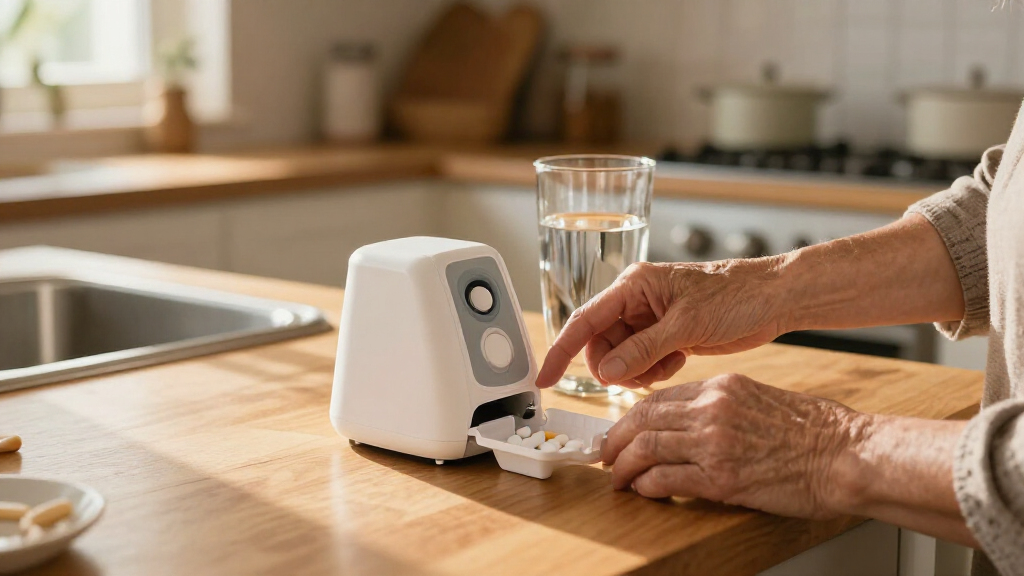
I compared these 15 dispensers by the tasks that shape daily use: whether doses are separated and released on schedule, how clearly alarms communicate a missed dose, how difficult it is to access extra medication, and how much effort refilling and programming may require. I also weighed capacity, interface design, physical retrieval features, and whether connected functions appear to offer a practical benefit for a senior-care routine. Product names and listed features provide the basis for these comparisons; I do not treat unlisted capabilities as confirmed.
The ranking favors a balanced design that can support routine use without making setup needlessly complicated. That puts the Live Fine 28-day locking model first for its blend of capacity and restricted access, while the Med-Q ranks as a simpler reminder-oriented alternative and the Wi-Fi rising-pod model serves households prioritizing remote monitoring. App-based and higher-capacity units rank well for specific needs, but not automatically above simpler models: added controls matter only if the user or caregiver can manage them. Before buying, confirm medication fit, schedule compatibility, and the dispenser’s exact alert and power behavior with the manufacturer.
| automatic pill dispensers for senior | Display |
|---|---|
| Live Fine Automatic Locking Pi | Jumbo LCD |
| Med-Q Electronic Pill Dispense | — |
| 28-Day Automatic Pill Dispense | — |
| Colorwing Smart Pill Dispenser | — |
| 28-Day Automatic Pill Dispense | LCD |
| Automatic Pill Dispenser with | LCD |
| Automatic Pill Dispenser with | LCD with time, alarm settings, mode, and low-battery indicator |
| 21-Day Wi-Fi Automatic Pill Di | — |
| Automatic Pill Dispenser with | LCD |
| EziMedPil 28-Day Locked Automa | Large high-brightness LCD |
| LiveFine Automatic Pill Dispen | LCD with 12/24-hour formats and low-battery indicator |
| Automatic Pill Dispenser with | — |
| 42-Day Automatic Pill Dispense | LCD |
| Betife 28-Day Automatic Pill D | — |
| LiveFine Automatic Pill Dispen | Jumbo LCD |
Factors to Consider When Choosing Automatic Pill Dispensers For Seniors
Choosing a dispenser is less about collecting the most features and more about deciding which person will handle each part of the routine. I would start with the senior’s medication schedule and abilities, then check how a caregiver will refill, troubleshoot, and respond to missed doses.
Match the compartment layout to the actual schedule
Capacity labels such as 21-day, 28-day, or 42-day do not tell the whole story: some designs may allocate compartments by day, while the user’s routine may require multiple doses each day. Write down every medication time and compare it with the dispenser’s stated dose capacity before ordering. A calendar with a long span can still be a poor match if the schedule needs more compartments than the unit provides. Check whether tablets of different sizes or shapes fit without crowding, and ask a pharmacist about medication handling where needed. Avoid choosing a longer capacity solely to reduce refills; an incompatible schedule can create more work and increase the chance of setup errors.
Choose safeguards that fit the person’s risks
A lock can limit access to future doses, which may help when someone is prone to taking medication twice or handling pills out of sequence. It can also create a problem if the user has difficulty with keys, latches, or asking for assistance. Think through who will hold the key or manage a digital code and what happens if that caregiver is unavailable. A lock is not a substitute for supervision or medication advice, and it may not be appropriate for every household. Match the level of restriction to a specific safety concern rather than assuming that the most secure-looking design is automatically the best choice.
Test the retrieval method against dexterity and vision
Alerting a user is only useful if they can identify and retrieve the dose. A slide door, rising pod, or removable cup may be easier for one person than a small opening or loose pills, but the right mechanism depends on hand strength, coordination, and eyesight. Look for clearly labeled controls and a display that can be read at the user’s normal viewing distance. Ask the senior to handle a similar latch or container before settling on a design when possible. Do not assume that a larger unit is easier to operate; extra buttons and setup steps can offset a more accessible pill tray.
Decide whether connected monitoring will be used
Bluetooth, Wi-Fi, and app control can help a caregiver check in or manage settings from another location, but only if someone will actively use those tools. Confirm who owns the phone, who receives notifications, and whether the senior can still use the dispenser when a phone or internet connection is unavailable. App setup may require account creation, pairing, and ongoing troubleshooting that a simple alarm unit avoids. Remote alerts also do not guarantee that a dose was swallowed. Pay for connected features when they solve a real communication gap, not just because they appear more advanced.
Plan the refill and maintenance routine before buying
A dispenser transfers organization work; it does not remove it. Decide who will sort pills, verify each compartment, and refill the unit on a regular schedule, especially when the user has several prescriptions or frequent changes. Removable cups can simplify handling for some caregivers, while a longer capacity may reduce how often refills happen but increase the amount of medication loaded at once. Check the manufacturer’s instructions for cleaning, power, alarms, and backup behavior rather than assuming these details are the same across models. A reliable routine with a designated person is often more useful than extra capacity that no one has time to manage carefully.
Set the right budget for the support you need
Paying more makes sense when a feature addresses a clear need, such as remote caregiver oversight, a larger compartment count, or a retrieval method that the user can manage. A senior who only needs a recurring sound or light cue may be better served by a simpler device with fewer setup demands. Compare the cost of added complexity in time: app pairing, digital lock management, and more elaborate programming all need someone responsible for them. Ask whether support, replacement parts, or clear instructions are available before committing to a feature-heavy model. The best value is the dispenser that fits the routine and can be maintained, not the one with the longest feature list.
Frequently Asked Questions
Should I choose a locked dispenser if the senior can usually manage medication alone?
Not automatically. A lock may help prevent access to doses scheduled for later, but it can frustrate someone who has difficulty with keys, codes, or asking for help. First identify the specific risk, such as taking a dose twice or confusing compartments, and discuss it with the senior and their care team. If the user can follow a routine reliably, a simpler alarm model may involve less daily friction. Choose a lock only when its added control outweighs the access burden for that person.
Is a 28-day or 42-day dispenser better for a senior taking several medications each day?
The day count alone cannot answer that question; the number of dose compartments and the medication schedule matter more. List each medication time across a typical day, then compare that pattern with the model’s compartment layout and instructions. A 42-day unit may reduce refill frequency but still fail to fit a schedule with multiple daily doses. Confirm whether the medications are suitable for the dispenser and whether the compartments can hold the required pills. If the layout is unclear, ask the manufacturer or pharmacist before purchasing.
Do app alerts or Wi-Fi monitoring mean a caregiver can rely on the dispenser from another home?
Connected alerts can improve communication, but they should not be treated as proof that medication was taken. Check exactly what event triggers a notification and whether the app reports a missed opening, a reminder, or another status. Decide who will receive alerts and what that person will do if one arrives. Also plan for lost internet access, phone changes, and account or pairing problems. Remote monitoring works best as one part of a care plan, not as a replacement for direct support when it is needed.
What should I verify before loading prescriptions into an automatic dispenser?
Confirm that the dispenser’s schedule, compartment size, and medication-handling instructions match the person’s prescriptions. Some medicines may have storage or packaging requirements that make a particular dispenser unsuitable, so ask a pharmacist before moving pills from their original containers. Check how dose changes will be recorded and who will update the compartments when a prescription changes. Make sure the person responsible for filling the unit can identify each medication and verify the schedule. Keep the pharmacy’s instructions and the dispenser manual available for everyone involved in care.
Is an alarm-only model a sensible choice if a family member cannot manage an app?
Yes, when the main need is a reminder and the senior or a local caregiver can handle setup and refills. An alarm-only design avoids phone pairing, account management, and internet dependence, which can make daily operation easier. The tradeoff is that a remote family member may have fewer ways to check whether a dose was accessed. Consider who can respond in person if the senior misses a reminder. If remote oversight is a firm requirement, compare connected models while checking what their alerts actually report.
Conclusion
For most households, I recommend the Live Fine Automatic Locking Pill Dispenser, 28-Day, Frosted Lid as the best overall pick because its long capacity and locking design address two common needs without making app control the focus. The Med-Q Electronic Pill Dispenser is my best choice for beginners who want electronic reminders without prioritizing connected management, while the 21-Day Wi-Fi dispenser with rising pods is better for families seeking remote monitoring and a distinct retrieval method. For best value, I would compare the simpler alarm models against the user’s schedule and access needs rather than pay for app features that will go unused. The 42-day, multi-tray and app-controlled designs suit buyers who need more capacity or caregiver controls and have someone ready to manage setup. Before choosing, verify schedule fit, medication compatibility, and who will handle refills; those details matter more than a feature list on its own.