Senior-friendly hearing aids should be easy to handle, comfortable to wear, and suited to the listener’s hearing needs—not just packed with features. My best overall pick is the ELEHEAR Beyond OTC Bluetooth Hearing Aids for its AI speech enhancement and Bluetooth features; the EarCentric EasyCharge stands out for its desktop charger and portable case, while the ZAVYVAZ GM-922 offers 32-channel adjustment options. Buyers must balance simple controls and reliable charging against discreet fit, connectivity, and fine-tuning. Read on for the full breakdown of all 15 options and help choosing the right style.

Turn quiet afternoons into listening time
- Thousands of audiobooks, podcasts and originals
- Listen on your phone, tablet or Echo — also offline
- Cancel anytime
Complete the kit



Key Takeaways
- Speech-focused features distinguish the ELEHEAR Beyond models: the Beyond pairs AI speech enhancement with Bluetooth, while the Beyond 2 Pro is a separate option for shoppers comparing a more advanced ELEHEAR model.
- Charging convenience is a practical differentiator: EarCentric EasyCharge includes a desktop charger and portable case, a useful setup for people who prefer a familiar place to charge their devices.
- More channels can mean more adjustment choices, not automatically better hearing: the ZAVYVAZ GM-922’s 32-channel design stands out on paper, but ease of adjustment and a suitable fit still matter.
- In-ear and behind-the-ear designs ask buyers to make different compromises: in-ear models such as AOLIGI and Oricle favor a less visible fit, while behind-the-ear options such as EYOUBE and EarCentric are easier to handle for some users.
- Several listings share the Karthus name or similar rechargeable basics: compare the exact model, included accessories, controls, and fit rather than assuming similar branding means identical features.
| Karthus Rechargeable OTC Hearing Aids for Seniors and Adults |  | Best for Long Wear Between Charges | Type: OTC hearing aids | Design: Compact, discreet in-ear | Listening modes: Quiet Mode; Noise-Canceling Mode | VIEW LATEST PRICE | See Our Full Breakdown |
| NOLGESK OTC Rechargeable Hearing Aids for Seniors |  | Best for Simple Volume Adjustments | Model: GM-901T | Fit: In-ear, both ears | Hearing loss range: Mild to moderate | VIEW LATEST PRICE | See Our Full Breakdown |
| Karthus Rechargeable In-Ear Hearing Aids for Seniors with Noise Reduction |  | Best for Hands-Off Daily Use | Model: EC18-06 | Fit: In-ear | Listening modes: Noise Reduction; Quiet | VIEW LATEST PRICE | See Our Full Breakdown |
| ZAVYVAZ GM-922 Rechargeable 32-Channel OTC Hearing Aids |  | Best for Digital Processing Detail | Model: GM-922 | Type: OTC in-ear hearing aids | Processing: 32-channel digital | VIEW LATEST PRICE | See Our Full Breakdown |
| EYOUBE Rechargeable OTC Behind-the-Ear Hearing Aids with Noise Cancellation |  | Best Behind-the-Ear Option | Fit type: Behind-the-ear | Part number: Nihi101 | Battery life: Up to 18 hours | VIEW LATEST PRICE | See Our Full Breakdown |
| Karthus Rechargeable OTC Hearing Aids for Seniors |  | Best for Simple Controls | Fit: Behind-the-ear (RIC) | Sound processing: 16-channel DSP | Listening modes: Quiet Mode and Noise Mode | VIEW LATEST PRICE | See Our Full Breakdown |
| Qnmittry JH-A260 Rechargeable In-Ear Hearing Amplifiers with Charging Case, Blue and Red |  | Best for Minimal Controls | Model: JH-A260 | Fit: In-ear | Controls: Button control with 5 volume levels | VIEW LATEST PRICE | See Our Full Breakdown |
| ELEHEAR Beyond OTC Bluetooth Hearing Aids with AI Speech Enhancement |  | Best for App Customization | Design: Receiver-in-the-canal | Technology: VocClear AI | Maximum gain: Up to 50 dB | VIEW LATEST PRICE | See Our Full Breakdown |
| AOLIGI Rechargeable Invisible In-Ear OTC Hearing Aids |  | Best for Discreet Wear | Fit: In-ear, in-canal | Weight per device: 0.1 oz | Listening modes: 2: Normal and Restaurant | VIEW LATEST PRICE | See Our Full Breakdown |
| Karthus Rechargeable OTC Hearing Aids for Seniors |  | Best for Phone-Free Daily Use | Fit: Behind-the-ear | Processing: 16-channel digital | Hearing modes: Quiet Mode and Noise Mode | VIEW LATEST PRICE | See Our Full Breakdown |
| ELEHEAR Beyond 2 Pro OTC Rechargeable Hearing Aids |  | Best for App-Based Fine-Tuning | Type: OTC rechargeable hearing aids | Fit: Behind-the-ear, receiver-in-canal | Intended hearing loss: Perceived mild to moderate | VIEW LATEST PRICE | See Our Full Breakdown |
| EarCentric EasyCharge Rechargeable OTC Hearing Aids, Behind-the-Ear Pair with Desktop Charger and Portable Case, Beige |  | Best for Flexible Charging | Model: EasyCharge EX2 | Type: Behind-the-ear OTC hearing aids | Quantity: Pair | VIEW LATEST PRICE | See Our Full Breakdown |
| Oricle Standard 2.0 Rechargeable In-Ear Hearing Aids with Noise Reduction and Charging Case |  | Best for Simple In-Ear Controls | Model: Standard 2.0 | Model number: HA-JHA490-2.0 | Fit type: In-ear | VIEW LATEST PRICE | See Our Full Breakdown |
| Rechargeable Behind-the-Ear Hearing Aids with Noise Reduction and Charging Case | 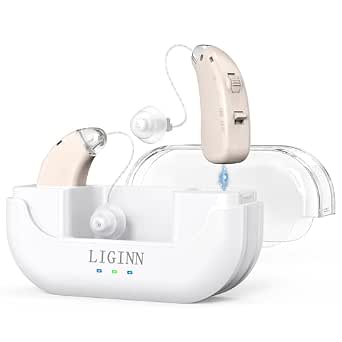 | Best for Straightforward, Phone-Free Use | Fit: Behind-the-ear | Intended hearing loss: Mild to moderate | Weight: 4.1 g | VIEW LATEST PRICE | See Our Full Breakdown |
| ELEHEAR Delight MW5 OTC Hearing Aids |  | Best for Earbud-Style Streaming | Model: ELEHEAR Delight MW5 | Fit: In-ear with ergonomic ear-wing | Sound processing: VocClear AI, adaptive noise cancellation, feedback cancellation | VIEW LATEST PRICE | See Our Full Breakdown |
| senior-friendly hearing aid | Battery life | Fit |
|---|---|---|
| Karthus Rechargeable OTC Heari | — | — |
| NOLGESK OTC Rechargeable Heari | — | In-ear, both ears |
| Karthus Rechargeable In-Ear He | Up to 24 hours per charge; up to 96 hours with charging case | In-ear |
| ZAVYVAZ GM-922 Rechargeable 32 | — | Universal fit for either ear |
| EYOUBE Rechargeable OTC Behind | Up to 18 hours | — |
| Karthus Rechargeable OTC Heari | Up to 30 hours per charge; up to 100 hours with charging case | Behind-the-ear (RIC) |
| Qnmittry JH-A260 Rechargeable | Up to 60 hours per charge (claimed) | In-ear |
| ELEHEAR Beyond OTC Bluetooth H | Up to 20 hours per charge; up to 100 hours with charging case | — |
| AOLIGI Rechargeable Invisible | At least 48 hours with charging case | In-ear, in-canal |
| Karthus Rechargeable OTC Heari | Up to 30 hours per charge; up to 100 hours with charging case | Behind-the-ear |
| ELEHEAR Beyond 2 Pro OTC Recha | Up to 20 hours per charge | Behind-the-ear, receiver-in-canal |
| EarCentric EasyCharge Recharge | Up to 12 days with portable case | — |
| Oricle Standard 2.0 Rechargeab | Up to 60 hours on a single charge | — |
| Rechargeable Behind-the-Ear He | — | Behind-the-ear |
| ELEHEAR Delight MW5 OTC Hearin | Up to 13.5 hours per charge | In-ear with ergonomic ear-wing |
More Details on Our Top Picks
Karthus Rechargeable OTC Hearing Aids for Seniors and Adults
For someone who wants a discreet in-ear pair with little need to manage charging during the day, this Karthus model stands out for its 24+ hours per charge and a case rated for 72+ hours of total use. Its Quiet and Noise-Canceling modes offer a basic way to adjust listening for different surroundings, while feedback and background-noise processing may help keep everyday sound less distracting. Compared with the Karthus EC18-06, it specifies longer total use with its case less clearly but avoids the other model’s six-level volume-control promise; neither listing provides detailed fit adjustments. The main tradeoff is a limited two-mode setup and no stated volume controls or ear-tip choices, which may matter to buyers who want to fine-tune comfort and sound. It is a straightforward pick, not a highly customizable one.
Pros:- Rated for more than 24 hours of use per charge
- Charging case adds over 72 hours of total stated use
- Quiet and Noise-Canceling modes suit different listening settings
- Compact in-ear design and stated feedback reduction
Cons:- Only two listening modes are specified
- No fit options or volume-adjustment controls are described
- Intended for adults 18 and older, so the listing does not define a senior-specific hearing range
Best for: Adults seeking discreet in-ear hearing aids with long stated use between charges and simple listening modes
Not ideal for: Buyers who need several volume steps, detailed fit options, or clear information about sound adjustment controls
- Type:OTC hearing aids
- Design:Compact, discreet in-ear
- Listening modes:Quiet Mode; Noise-Canceling Mode
- Full charge time:2 hours
- Use per charge:24+ hours
- Total use with charging case:72+ hours
- Intended users:Adults aged 18 and older
- Color:Black
Our verdict“Choose this Karthus pair if long stated battery life and a discreet fit matter more than detailed sound controls.”
NOLGESK OTC Rechargeable Hearing Aids for Seniors
The NOLGESK GM-901T makes the most sense for someone who wants a small number of clear control steps rather than extra connectivity or app features. Its four volume levels and simple button controls offer more direct adjustment than the Karthus model with only two stated listening modes. Six pairs of silicone tips also give buyers more opportunity to find a comfortable in-ear fit, an advantage over products in this group that do not list tip choices. The charging case is rated for 80–100 hours of total use, though actual runtime varies with settings, so I would treat that as a variable rather than a fixed schedule. Its limits are its mild-to-moderate hearing-loss target and lack of Bluetooth or advanced controls. Buyers who need phone or TV streaming should look elsewhere.
Pros:- Four volume levels provide straightforward sound adjustment
- Includes six pairs of silicone ear tips for fit selection
- Noise reduction and feedback suppression are specified
- Charging case is rated for up to 80–100 hours of total use
Cons:- No Bluetooth or advanced features are listed
- Actual battery life varies with volume and settings
- Specified for mild to moderate hearing loss
Best for: Adults with mild to moderate hearing loss who prefer button controls, a few volume steps, and several ear-tip sizes
Not ideal for: Buyers who want Bluetooth streaming, app-based tuning, or a clearly fixed runtime across listening settings
- Model:GM-901T
- Fit:In-ear, both ears
- Hearing loss range:Mild to moderate
- Volume levels:4
- Noise control:Environmental noise cancellation and feedback suppression
- Battery:Rechargeable lithium-ion
- Total usage time:Up to 80–100 hours with charging case; varies by settings
- Included ear tips:6 pairs
- Color:Black
Our verdict“Pick the NOLGESK if simple volume buttons and a range of ear tips are higher priorities than streaming or app controls.”
Karthus Rechargeable In-Ear Hearing Aids for Seniors with Noise Reduction
Automatic power-on gives the Karthus EC18-06 a useful simplicity advantage for people who prefer not to manage a series of startup steps. It also offers six volume levels, more adjustment than the four on the NOLGESK GM-901T, plus Noise Reduction and Quiet modes for different listening situations. The Type-C case is rated for up to 96 hours of total use, although that figure includes case power rather than a single charge; one charge is rated for up to 24 hours. Compared with the first Karthus model here, this one provides more stated volume steps and includes cleaning tools and domes, but it is still aimed at perceived mild to moderate hearing loss and has no app or Bluetooth. Buyers should be comfortable with basic onboard controls rather than phone-based tuning.
Pros:- Six volume levels allow more adjustment than four-level alternatives
- Automatic power-on reduces startup steps
- Up to 24 hours per charge and up to 96 hours with the case are specified
- Package includes domes, wax guard tools, and a cleaning brush
Cons:- No app or Bluetooth connectivity
- Designed for perceived mild to moderate hearing loss
- The 96-hour figure includes charging-case capacity rather than one charge
Best for: Adults with perceived mild to moderate hearing loss who want automatic startup, multiple volume levels, and included cleaning tools
Not ideal for: People who want Bluetooth or app control, or who need hearing support beyond the stated mild-to-moderate range
- Model:EC18-06
- Fit:In-ear
- Listening modes:Noise Reduction; Quiet
- Volume levels:6
- Battery life:Up to 24 hours per charge; up to 96 hours with charging case
- Charging:Type-C rechargeable case
- Controls:Automatic power-on; no app or Bluetooth required
- Weight:3.13 g
- Included components:2 hearing aids, charging case, 2 wax guard tools, 2 domes, cleaning brush, charging cable
Our verdict“Choose the EC18-06 if you want automatic startup and more volume steps than the NOLGESK, without needing wireless features.”
ZAVYVAZ GM-922 Rechargeable 32-Channel OTC Hearing Aids
The GM-922 is the processing-focused choice in this group: its 32-channel digital system, noise control, and feedback control are intended to support clearer listening for mild to moderate hearing loss. That makes it a stronger fit for buyers who value specified digital processing over the simpler mode descriptions on the two Karthus models. It also fits either ear and includes seven silicone ear domes, giving users more fit options than the NOLGESK’s six pairs. The tradeoff is a shorter stated run time of 18–20 hours per charge, despite the case providing 100+ hours of backup. There is no Bluetooth, so it cannot connect to a phone or TV. I would choose it for processing and fit flexibility, not wireless listening or all-day use without recharging.
Pros:- 32-channel digital processing is specified
- Noise and feedback control support clearer everyday listening
- Universal fit works in either ear and seven ear domes are included
- Case is rated for 100+ hours of backup use
Cons:- No Bluetooth connection to phones, TVs, or other devices
- Operating time is 18–20 hours per charge
- Intended for mild to moderate hearing loss
Best for: Adults with mild to moderate hearing loss who want specified multi-channel processing and several dome options
Not ideal for: Buyers who want to stream audio from phones or TVs, or who need more than 20 hours from a single charge
- Model:GM-922
- Type:OTC in-ear hearing aids
- Processing:32-channel digital
- Fit:Universal fit for either ear
- Charging time:About 2 hours
- Operating time:18–20 hours per charge
- Charging case backup:100+ hours
- Connectivity:No Bluetooth
- Included ear domes:7 silicone domes
Our verdict“Choose the GM-922 if multi-channel processing and fit choices matter more than Bluetooth or a longer single-charge runtime.”
EYOUBE Rechargeable OTC Behind-the-Ear Hearing Aids with Noise Cancellation
Unlike the four in-ear options above, EYOUBE uses a behind-the-ear fit, which may suit buyers who find small in-ear devices difficult to handle or uncomfortable. Its DSP processing, adjustable sound, and active noise cancellation are described for calls, conversation, TV, music, and outdoor settings, so the intended use is broad. The stated runtime is up to 18 hours, shorter than the longer case-based totals listed for the Karthus and NOLGESK pairs. The key drawback is how little detail supports its performance claims: the listing does not specify adjustment steps, fit components, or independent performance data. Compared with the ZAVYVAZ GM-922, it offers a different, behind-the-ear style but lacks a stated channel count and case-backup figure. Choose it for the form factor, with modest expectations about documented tuning.
Pros:- Behind-the-ear design offers an alternative to small in-ear devices
- DSP processing and adjustable sound are described
- Active noise cancellation is listed
- Recommended for calls, conversation, TV, music, and outdoor activities
Cons:- Up to 18 hours of battery life is shorter than several case-backed options here
- No independent performance details are provided
- Adjustment steps, hearing-loss range, and charging-case capacity are not specified
Best for: Adults who prefer a behind-the-ear device and want adjustable sound for conversation, TV, or calls
Not ideal for: Buyers who need detailed fit and tuning information, documented case capacity, or a clearly specified hearing-loss range
- Fit type:Behind-the-ear
- Part number:Nihi101
- Battery life:Up to 18 hours
- Battery type:NiMH, rechargeable
- Noise control:Active noise cancellation
- Sound processing:DSP processing; adjustable sound
- Color:Skin
- Recommended uses:Watching TV, listening to music, phone calls, conversation, outdoor activities, noisy settings
Our verdict“Consider EYOUBE if you prefer a behind-the-ear fit, but choose a more fully specified model if tuning details or battery backup are priorities.”
Karthus Rechargeable OTC Hearing Aids for Seniors
For someone who wants to adjust hearing aids without a phone, this Karthus pair keeps the routine direct: physical buttons control seven volume levels, and two modes cover quieter conversations and noisier settings. Its behind-the-ear RIC fit may also be easier to handle than the tiny in-canal AOLIGI, particularly for people who find small devices difficult to place. The stated 30-hour runtime per charge and up to 100 hours with the case reduce how often charging needs attention; a 15-minute quick charge is useful when the aids are unexpectedly low. The tradeoff is limited flexibility compared with the app-customized ELEHEAR Beyond, and this model is intended for mild to moderate hearing loss, not severe loss. Fit and results can also vary by ear and environment.
Pros:- Button controls provide seven volume levels without a smartphone.
- Two modes offer a straightforward way to switch between quieter and noisier settings.
- Up to 30 hours per charge and up to 100 hours with the charging case are stated.
- Lightweight behind-the-ear RIC design is described as suitable for use with glasses.
Cons:- No app or Bluetooth connectivity for customized settings or wireless audio.
- Designed for mild to moderate hearing loss rather than severe or profound loss.
- Fit and listening results may vary by person and environment.
Best for: Adults with mild to moderate hearing loss who prefer tactile controls, do not want app setup, and value long stated battery life.
Not ideal for: People with severe or profound hearing loss, or buyers who want app-based sound adjustments and Bluetooth features.
- Fit:Behind-the-ear (RIC)
- Sound processing:16-channel DSP
- Listening modes:Quiet Mode and Noise Mode
- Volume levels:7
- Controls:Buttons; no app or smartphone setup required
- Battery life:Up to 30 hours per charge; up to 100 hours with charging case
- Quick charge:15 minutes provides up to 6 hours of use
- Intended hearing loss:Mild to moderate
Our verdict“Choose this Karthus pair if straightforward buttons and extended stated runtime matter more than app customization or wireless features.”
Qnmittry JH-A260 Rechargeable In-Ear Hearing Amplifiers with Charging Case, Blue and Red
The JH-A260 suits buyers who want a compact in-ear amplifier with a simple control scheme: one button cycles through five volume levels, while adaptive noise reduction is intended to help speech stand out from background sound. Its charging case handles automatic power on and off, avoiding some manual steps. That simplicity contrasts with the Karthus behind-the-ear pair, which offers two named listening modes and more volume levels for people who want clearer control over different environments. Qnmittry’s listed battery claims are especially generous—up to 60 hours per charge and over 110 hours of case backup—but the product information does not explain how those figures are measured, so I would treat them as claims rather than a guarantee. Buyers also get no described fit adjustments or multiple modes, and the listed weight figures conflict.
Pros:- Single-button operation provides five volume levels.
- Adaptive noise reduction is designed to prioritize speech over background noise.
- Charging case is described as automatically powering the devices on and off.
- Compact in-ear style avoids the behind-the-ear form of the Karthus options.
Cons:- No multiple listening modes or individual fit adjustments are described.
- Battery-life figures are product claims and may vary with actual use.
- Product information lists conflicting weight figures.
Best for: Adults seeking a small in-ear amplifier with one-button volume adjustment and automatic case operation, without a need for multiple listening modes.
Not ideal for: Buyers who want selectable environment modes, detailed fit options, or clearly consistent device-weight information.
- Model:JH-A260
- Fit:In-ear
- Controls:Button control with 5 volume levels
- Noise feature:Adaptive noise reduction
- Battery life:Up to 60 hours per charge (claimed)
- Charging case backup:Over 110 hours (claimed)
- Case operation:Automatic power on/off
- Color:Blue and red
Our verdict“Pick the Qnmittry if compact in-ear wear and minimal button control matter more than selectable listening modes or detailed fit guidance.”
ELEHEAR Beyond OTC Bluetooth Hearing Aids with AI Speech Enhancement
Among these five, the ELEHEAR Beyond is the clearest fit for someone willing to use a smartphone to tailor listening. Its VocClear AI speech enhancement, noise attenuation, and feedback control aim to make speech easier to follow, while the ELEHEAR app adds customizable settings that the button-only Karthus models do not offer. Multiple dome sizes give buyers a way to adjust the fit, and the case’s automatic power behavior can simplify daily handling. The tradeoff is a greater setup burden: some smart features require the app, so this is less appealing to a person who wants to adjust everything on the device itself. Runtime is stated at up to 20 hours per charge, shorter than Karthus’s stated 30 hours, though the case brings total use to up to 100 hours. It is intended for mild to moderate hearing loss.
Pros:- VocClear AI is designed to enhance speech and reduce background noise.
- Feedback control addresses an irritating issue that can affect hearing-aid use.
- App offers customizable settings for listeners who want more adjustment than the Karthus button controls provide.
- Multiple dome sizes and automatic case operation support fit adjustment and daily handling.
Cons:- Some smart features depend on the companion app.
- Up to 20 hours per charge is less than the Karthus models’ stated 30 hours.
- Designed for mild to moderate hearing loss, not severe loss.
Best for: Adults with mild to moderate hearing loss who are comfortable using an iOS or Android app and want customizable listening settings and speech-focused processing.
Not ideal for: People who avoid smartphones, want the longest stated runtime between charges, or need support for severe hearing loss.
- Design:Receiver-in-the-canal
- Technology:VocClear AI
- Maximum gain:Up to 50 dB
- Noise attenuation:24 dB
- Battery life:Up to 20 hours per charge; up to 100 hours with charging case
- Connectivity:Bluetooth
- App compatibility:ELEHEAR app for iOS and Android
- Fit options:Multiple dome sizes
Our verdict“Choose ELEHEAR Beyond if app-based tuning and speech-focused processing outweigh the need for phone-free controls and longer per-charge runtime.”
AOLIGI Rechargeable Invisible In-Ear OTC Hearing Aids
AOLIGI’s main advantage is its in-canal profile: it is the discreet choice in this group for someone who would rather avoid the visible behind-the-ear shape of either Karthus model. The small devices still provide practical controls—two modes, five volume levels, and buttons—so adjusting them does not depend on an app. Normal and Restaurant modes offer a little more environmental choice than the Qnmittry JH-A260, which lists no selectable modes. Three silicone earplug sizes may help with fit, though comfort will still depend on the wearer’s ear. The stated minimum of 48 hours with the case and two-hour charging time are useful planning details, but the product data does not give a per-charge runtime. Its two preset modes also provide less flexibility than the ELEHEAR Beyond’s app customization.
Pros:- In-canal design is more discreet than the behind-the-ear Karthus models.
- Two listening modes and five volume levels offer direct adjustments.
- Three earplug sizes provide options for adapting the fit.
- Auto on/off and a memory function are described as simplifying routine use.
Cons:- Only Normal and Restaurant modes are listed, with less customization than ELEHEAR Beyond.
- Fit and comfort may vary by ear.
- The provided battery figure covers use with the case but does not specify per-charge runtime.
Best for: Adults with mild hearing needs who prioritize a low-visibility in-canal design and want basic button controls without app setup.
Not ideal for: People who need many listening profiles, prefer larger devices that may be easier to handle, or want a stated per-charge runtime.
- Fit:In-ear, in-canal
- Weight per device:0.1 oz
- Listening modes:2: Normal and Restaurant
- Volume levels:5
- Earplug sizes:Small, medium, and large
- Charging time:2 hours
- Battery life:At least 48 hours with charging case
- Controls:Buttons; automatic on/off and memory function
Our verdict“Choose AOLIGI if discreet in-canal wear is your priority and two preset modes are enough for your usual listening situations.”
Karthus Rechargeable OTC Hearing Aids for Seniors
This black Karthus model makes sense for seniors who want a dependable, phone-free routine: one-button controls, seven volume levels, and two modes cover basic adjustments without Bluetooth, an app, or wireless setup. Its 16-channel digital processing is intended to improve speech clarity and reduce background noise, while the behind-the-ear fit keeps the controls accessible compared with the less visible but smaller AOLIGI in-canal aids. The stated runtime matches the other Karthus entry—up to 30 hours per charge and 100 hours with the case—and a 15-minute quick charge provides a useful backup. That overlap means the choice between the Karthus models comes down chiefly to this version’s black color and listed one-button control details, not a clear performance advantage. Buyers who want streaming or app tuning should choose ELEHEAR Beyond instead.
Pros:- One-button control and seven volume levels avoid smartphone setup.
- Two modes provide a basic adjustment for quiet and noisier environments.
- Up to 30 hours per charge and 100 hours with the case are stated.
- 15-minute quick charge is listed as providing up to 6 hours of use.
Cons:- No app, Bluetooth, or wireless function for streaming or customization.
- Designed for mild to moderate hearing loss.
- Offers no clear battery advantage over the other Karthus model in this roundup.
Best for: Seniors with mild to moderate hearing loss who want simple, tactile controls, a behind-the-ear fit, and no phone or wireless setup.
Not ideal for: People seeking Bluetooth streaming, app-based personalization, or amplification intended for severe or profound hearing loss.
- Fit:Behind-the-ear
- Processing:16-channel digital
- Hearing modes:Quiet Mode and Noise Mode
- Volume levels:7
- Controls:One-button control
- Battery life:Up to 30 hours per charge; up to 100 hours with charging case
- Quick charge:15 minutes
- Connectivity:No app, Bluetooth, or wireless function
Our verdict“Choose this Karthus if you want a black, phone-free behind-the-ear aid with straightforward controls, not wireless features or app tuning.”
ELEHEAR Beyond 2 Pro OTC Rechargeable Hearing Aids
For seniors who want hearing support alongside phone audio and calls, the ELEHEAR Beyond 2 Pro offers a feature-rich behind-the-ear option. Its speech enhancement and feedback suppression are intended to help in noisy settings, while the ELEHEAR app provides sound adjustments and access to remote review by a licensed hearing professional. Compared with the simpler Rechargeable Behind-the-Ear Hearing Aids with Noise Reduction, this model adds Bluetooth 5.3 streaming and app controls, but those extras also mean more setup and reliance on a compatible smartphone.
The rechargeable aids run for up to 20 hours per charge, and the case supplies four additional charges. IP67 protection adds reassurance around water and dust. The tradeoff is that adjustments require the app, and this is not an Apple MFi hearing aid; optional live video fine-tuning is also limited to 27 U.S. states. I’d skip it for anyone seeking a straightforward, phone-free control experience.
Pros:- Speech enhancement and feedback suppression target listening challenges in noisy settings.
- Bluetooth supports audio streaming and hands-free calls with compatible devices.
- The case supplies four additional charges beyond up to 20 hours per charge.
- App-based adjustments and remote review by a licensed hearing professional are available.
Cons:- Sound adjustments require the ELEHEAR app, which may be a hurdle for phone-averse users.
- It is not an Apple MFi hearing aid.
- Optional live video fine-tuning is available only in 27 U.S. states.
Best for: Seniors with perceived mild-to-moderate hearing loss who use an iPhone or Android phone and want app adjustments, streaming, and access to remote professional review.
Not ideal for: People who do not use a compatible smartphone, want physical-first adjustments, or need prescription care for more severe hearing loss.
- Type:OTC rechargeable hearing aids
- Fit:Behind-the-ear, receiver-in-canal
- Intended hearing loss:Perceived mild to moderate
- Bluetooth:Bluetooth 5.3
- Compatibility:iPhone with iOS 15 or later; Android 8.0 or later
- Battery life:Up to 20 hours per charge
- Charging case:Provides 4 additional charges
- Water and dust resistance:IP67
- Weight per aid:4.3 g
Our verdict“Choose the ELEHEAR Beyond 2 Pro if you want app-led adjustment, phone connectivity, and remote review, and are comfortable managing hearing aids through a smartphone.”
EarCentric EasyCharge Rechargeable OTC Hearing Aids, Behind-the-Ear Pair with Desktop Charger and Portable Case, Beige
The EarCentric EasyCharge EX2 is a practical pick for seniors who want more than one way to keep their hearing aids powered. Its desktop dock suits a regular home charging spot, while the portable case provides up to three extra charges for days away. That setup is a clearer advantage over the Oricle Standard 2.0, which emphasizes a long stated single-charge runtime but offers fewer details about charging flexibility. EasyCharge also includes several dome and tube options, giving wearers some room to adjust the fit.
Noise reduction and adjustable volume cover basic everyday needs without requiring app controls. The tradeoff is its behind-the-ear shape, which will not appeal to everyone, and the product data does not state how long software updates are supported. The listed battery duration is up to 12 days with the portable case, rather than a per-charge figure, so buyers should not read that as continuous wear time.
Pros:- Includes both a desktop charging dock and a portable charging case.
- Portable case provides up to three additional charges.
- Multiple ear domes and tube options allow some fit adjustment.
- Adjustable volume and noise reduction support basic listening adjustments.
Cons:- The behind-the-ear design may not suit wearers who prefer in-ear devices.
- Software update support duration is not specified.
- The up-to-12-day battery claim is tied to use with the case, not a stated per-charge runtime.
Best for: Seniors who want a home charging dock plus a portable backup case, and value included fit options for behind-the-ear wear.
Not ideal for: People who dislike behind-the-ear devices or want clearly documented app support, software update policies, or a simple per-charge battery-life figure.
- Model:EasyCharge EX2
- Type:Behind-the-ear OTC hearing aids
- Quantity:Pair
- Color:Beige
- Features:Rechargeable, noise reduction, adjustable volume, sweatproof
- Battery:Lithium-polymer, 3.7 V
- Battery life:Up to 12 days with portable case
- Item weight:1.2 oz
- Dimensions:1.4 × 0.5 in
Our verdict“Pick EasyCharge if a home dock, portable charging backup, and fit accessories matter more to you than app features or a clearly stated per-charge runtime.”
Oricle Standard 2.0 Rechargeable In-Ear Hearing Aids with Noise Reduction and Charging Case
For seniors who would rather avoid an over-ear hook, the Oricle Standard 2.0 uses a compact in-ear fit with soft silicone tips and physical button controls. Five sound levels give buyers preset choices without requiring an app, making it simpler to operate than the ELEHEAR Beyond 2 Pro, whose adjustments depend on a smartphone. Automatic on/off also cuts down on routine handling. Its stated up to 60 hours of use on a single charge is a standout claim, though the product details do not explain the conditions behind that figure.
The main compromise is limited control information: the listing does not say how users select among the five sound levels, so a new wearer may need to consult the guide or experiment. Compared with the EarCentric EasyCharge EX2, Oricle offers a less visible in-ear profile but fewer fit options are specified. I’d choose it for basic button-led use, not for buyers seeking a documented fitting process or advanced phone features.
Pros:- In-ear design with silicone tips avoids a behind-the-ear hook.
- Button controls and automatic on/off reduce reliance on a smartphone.
- Five sound levels provide preset adjustment choices.
- Portable charging case is included.
Cons:- The product details do not explain how to adjust among the five sound levels.
- The stated 60-hour single-charge runtime is not accompanied by usage conditions.
- No Bluetooth compatibility or professional fitting support is specified.
Best for: Seniors who prefer a compact in-ear style, want physical controls rather than app setup, and are comfortable with a small number of preset sound levels.
Not ideal for: Buyers who need detailed instructions for sound adjustment, multiple documented fit accessories, Bluetooth features, or professional fitting support.
- Model:Standard 2.0
- Model number:HA-JHA490-2.0
- Fit type:In-ear
- Material:Silicone
- Sound levels:5
- Battery life:Up to 60 hours on a single charge
- Battery:Lithium-ion
- Controls:Button control; long press for 5 seconds to turn on or off
- Included components:Hearing aids, case, charger
Our verdict“Choose Oricle if you want a compact, button-controlled in-ear aid and can accept limited detail about sound adjustment and the battery-life claim.”
Rechargeable Behind-the-Ear Hearing Aids with Noise Reduction and Charging Case
This model suits seniors who prefer physical controls over pairing, apps, or Bluetooth setup. Its button and volume controls keep everyday adjustments on the device, while multi-channel processing is designed to improve speech clarity and reduce background noise. Compared with the ELEHEAR Beyond 2 Pro, it gives up streaming and app-based tuning but asks less of the wearer’s phone skills. The 4.1 g behind-the-ear units are also lightweight, and three earplug sizes help users work toward a secure fit.
Battery life is a strong point: the aids run for up to 24 hours, and the case can charge them up to four times. USB-C charging is familiar for many households. This is still a basic OTC choice, not a substitute for prescription care, and fit matters: poorly seated earplugs can cause feedback whistling. New users may also need time to get used to wearing the devices, as with the more compact Oricle Standard 2.0.
Pros:- Physical button and volume controls work without app setup.
- Multi-channel processing is designed to support speech clarity and reduce background noise.
- Up to 24 hours of operating time per charge.
- USB-C case can recharge the aids up to four times and includes three earplug sizes.
Cons:- No Bluetooth streaming or app-based sound adjustments are specified.
- A poor earplug fit can cause feedback whistling.
- New wearers may need time to adjust to wearing hearing aids.
Best for: Seniors with mild-to-moderate hearing loss who want physical volume and button controls, rechargeable power, and no app or Bluetooth setup.
Not ideal for: People who want phone streaming or app personalization, or who find behind-the-ear devices uncomfortable and do not want to experiment with earplug fit.
- Fit:Behind-the-ear
- Intended hearing loss:Mild to moderate
- Weight:4.1 g
- Charging time:2–3 hours
- Operating time:Up to 24 hours
- Charging case capacity:Up to 96 hours; can charge the hearing aids up to 4 times
- Charging port:USB-C
- Battery:Lithium-ion, 3.7 V
- Controls:Button control and volume control
Our verdict“Choose this model if you want rechargeable behind-the-ear support with physical controls and can do without Bluetooth or app-based adjustments.”
ELEHEAR Delight MW5 OTC Hearing Aids
The ELEHEAR Delight MW5 is the most earbud-like choice in this group for seniors who want hearing support and everyday phone audio in one device. VocClear AI, adaptive noise cancellation, and feedback cancellation are designed to bring voices forward while limiting background sound. Bluetooth 5.3 supports streaming and hands-free calls, and app controls let users personalize settings. Compared with the behind-the-ear ELEHEAR Beyond 2 Pro, the MW5 trades a longer stated runtime and additional case charges for an in-ear form with an ergonomic ear-wing.
Each charge lasts up to 13.5 hours, with two extra recharges from the case; IP67 protection adds water and dust resistance. The tradeoff is shorter stated use between charges than Beyond 2 Pro’s up to 20 hours, and the in-ear style may be less comfortable for some wearers. The product data also warns that it may not meet the needs of people with severe hearing loss who require prescription hearing aids.
Pros:- VocClear AI and adaptive noise cancellation are designed to make voices clearer in background noise.
- Bluetooth 5.3 supports streaming and hands-free calls.
- App controls provide personalized sound adjustments.
- IP67 protection and a rechargeable case add everyday convenience.
Cons:- Up to 13.5 hours per charge is shorter than the Beyond 2 Pro’s stated 20 hours.
- In-ear earbud-style wear may not suit everyone.
- May not provide enough support for people with severe hearing loss who need prescription hearing aids.
Best for: Seniors with mild-to-moderate hearing needs who prefer an in-ear, earbud-style fit and want Bluetooth calls, streaming, and app-based sound settings.
Not ideal for: People with severe hearing loss who need prescription devices, anyone who dislikes in-ear wear, or users who prioritize longer per-charge runtime over streaming features.
- Model:ELEHEAR Delight MW5
- Fit:In-ear with ergonomic ear-wing
- Sound processing:VocClear AI, adaptive noise cancellation, feedback cancellation
- Connectivity:Bluetooth 5.3; app control for iOS and Android
- Battery life:Up to 13.5 hours per charge
- Charging case:Provides 2 additional recharges
- Water and dust resistance:IP67
- Battery type:Lithium-ion
- Included components:Two hearing aids, charging case, USB-C cable, 3 pairs of ear tips
Our verdict“Choose the Delight MW5 if you want an earbud-style OTC option with streaming and app controls, but not if you need prescription-level support or the longest runtime.”

How We Picked
I ranked these options around the needs that can make everyday hearing-aid use easier for older adults: straightforward controls, manageable fit, charging routine, listening features, and the likely learning curve. I also weighed whether a feature solves a real day-to-day problem. For example, a desktop charger may help someone who wants a consistent charging spot, while Bluetooth or speech enhancement may appeal to a person who often listens to calls or conversation in busy settings.
The order reflects the balance of those factors, not a claim that one design suits every listener. Options with a clear usability or listening advantage rise above models whose listed features offer less differentiation; premium-style features are ranked for buyers who will use them, not as an automatic upgrade. Product names and provided feature details do not establish medical suitability, hearing-loss severity, or prescription-level performance, so I treat those as questions buyers should confirm with a hearing professional. I also weigh meaningful limitations—including fit sensitivity, small controls, extra setup, and uncertainty when listings provide few specifics—alongside each option’s strengths.
Factors to Consider When Choosing Senior-friendly Hearing Aids
Before choosing among senior-friendly hearing aids, match the device to the person’s routine and dexterity as much as to its feature list. These decisions can prevent a common mistake: buying the most feature-rich option when a simpler shape, charger, or control scheme would be easier to use consistently.
Choose a style the wearer can handle
In-ear devices sit inside the ear and may be less visible, but their small size can make insertion, removal, and cleaning harder for someone with limited dexterity or vision. Behind-the-ear models have a larger body that may be easier to grip, though the fit can feel more noticeable and glasses or masks may compete for space. Ask the wearer to practice handling a demo device or a similarly sized object before choosing. Do not pick an invisible design solely for appearance if the wearer struggles with tiny parts. Comfort and independent handling often matter more than how discreet a device looks.
Match controls to vision, hearing, and dexterity
Look for controls the wearer can identify by touch and operate without repeatedly consulting a phone. Tiny buttons or app-only adjustments can be frustrating for people with reduced vision, tremor, or limited smartphone confidence. A family member may help with initial setup, but daily volume changes should remain manageable for the wearer. Ask whether controls provide clear feedback and whether settings remain in place after charging or switching the device off. A simpler interface can be a better fit than a long list of adjustments that rarely get used.
Plan for charging and daily maintenance
Rechargeable devices avoid routine battery replacement, but they still need a dependable charging habit. A desktop charger can make a fixed charging spot easier to remember; a portable case may help during outings, provided the wearer can open and position the devices comfortably. Check how the charging parts connect and whether the case is easy to carry and clean. Also account for earwax, moisture, and handling: filters and tips need attention, and a device left uncleaned can become uncomfortable or perform poorly. Choose a routine the wearer can maintain, or identify who will help.
Prioritize the listening situations that matter most
Think beyond the general goal of hearing better and name the situations that cause the most difficulty: one-on-one conversation, television, phone calls, or groups in noisy rooms. Speech enhancement or Bluetooth may be useful when those situations are central, but added functions can bring more setup and settings to manage. A person who mostly wants help with conversation at home may prefer straightforward operation over wireless features. Ask what the device can adjust and whether those changes are available on the hearing aid itself or require an app. Match the feature to a recurring need rather than treating a longer feature list as proof of better results.
Check OTC suitability and get hearing guidance
Over-the-counter hearing aids are intended for adults with perceived mild-to-moderate hearing loss, and they are not a substitute for a hearing evaluation when symptoms suggest another problem. Sudden hearing changes, pain, drainage, dizziness, or hearing that is much worse in one ear call for professional medical advice rather than an online purchase. A hearing professional can help distinguish hearing loss from wax buildup or other conditions and advise whether an OTC device is appropriate. Confirm the seller’s return window, support, and fitting instructions before buying, since comfort and sound settings may take adjustment. Do not assume a generic product listing provides the clinical support or follow-up of a hearing-care provider.
Know when paying for more features makes sense
Paying for connectivity, more adjustment options, or speech-processing features makes sense only when the wearer will use them and can operate them. A phone-savvy buyer who takes frequent calls may value Bluetooth, while another listener may gain more from a simple charger and tactile controls. More channels or app settings do not guarantee a better match if the device cannot be fitted comfortably or adjusted confidently. Compare the included accessories and support as well as the headline features. If the product information leaves questions about fit, service, or setup unanswered, clarify them before choosing rather than treating an advertised feature as a promise of results.
Frequently Asked Questions
Are OTC hearing aids a good choice for every older adult?
No. OTC hearing aids are intended for adults who perceive mild-to-moderate hearing loss, but they are not right for every cause or degree of hearing difficulty. Sudden changes, ear pain, drainage, dizziness, or a major difference between ears warrant medical guidance before buying. A hearing evaluation can also identify wax buildup or other issues that a device will not fix. When the situation is unclear, start with a qualified hearing or medical professional rather than guessing from a product description.
Should I choose in-ear or behind-the-ear hearing aids for someone with limited dexterity?
Behind-the-ear styles are often easier to grip because more of the device is exposed, while small in-ear models can be harder to insert, remove, and clean. That does not make every behind-the-ear device easy: tubing, tips, and controls still need handling, and fit varies. Consider the wearer’s vision, hand steadiness, and ability to feel which side is left or right. If possible, have them practice with the actual device or a fitting sample before committing. A less discreet style that the wearer can manage independently may be the more useful choice.
Is Bluetooth worth choosing if the wearer mainly wants help with conversation?
Bluetooth is most useful when the wearer expects to stream calls or audio from a compatible phone or device. It may add little value for someone who wants uncomplicated help during face-to-face conversation and does not use wireless settings. Pairing, app access, and troubleshooting can also create extra steps for a new user. Prioritize speech-focused functions and simple controls if conversation is the main goal. Check compatibility and how adjustments work before paying for connectivity the wearer may not use.
Do rechargeable hearing aids make daily use easier than replaceable-battery models?
Rechargeable models remove the recurring task of changing small batteries, which can help people with limited finger dexterity. They also require a reliable charging routine and a place to store the charger, so they are not automatically easier for everyone. Consider whether the wearer can position the aids correctly in the charging case and remember to charge them overnight. A desktop charger may suit a home routine, while a portable case can be handy away from home. Ask about charging guidance and what happens if the device is not charged before the next day.
What should I check before buying an online hearing aid?
Confirm that the device is intended for the wearer’s needs, then review its fitting steps, control method, included accessories, and support options. Check the return and trial terms carefully, since comfort and sound adjustment often need a real-world check. Look for clear cleaning instructions and learn whether replacement tips, filters, or other parts are available. Confirm phone compatibility if Bluetooth or an app is part of the decision. If hearing symptoms are sudden, painful, or markedly uneven, seek professional advice before ordering.
Conclusion
For the strongest feature mix in this roundup, I’d start with the ELEHEAR Beyond OTC Bluetooth Hearing Aids as the best overall, particularly for a wearer who values speech enhancement and phone connectivity. The EarCentric EasyCharge is my best value-oriented usability pick for someone who wants a desktop charging routine and portable case, while the ELEHEAR Beyond 2 Pro is the best premium-style choice for buyers comparing a more advanced feature set. For beginners, I’d favor the option whose controls and charging routine the wearer can manage confidently; the EarCentric’s fixed charging setup is a practical place to start. For a less visible fit, consider the AOLIGI or Oricle Standard 2.0, while the ZAVYVAZ GM-922 may appeal to shoppers seeking more adjustment channels. My final advice is to choose by fit, ease of daily handling, and support—not by the longest feature list—and seek professional guidance if the hearing problem is new or unusual.
Halloween Picks

Gemmy 6-Foot Leatherface Animatronic Halloween Decoration

8.5 Foot Halloween Inflatable Haunted House Castle with Skeleton, Ghost & Skulls

Halloween Inflatable Haunted House Maze – 20×20 ft with Removable Roof and Blower
As an affiliate, we earn on qualifying purchases.