
TL;DR

Turn quiet afternoons into listening time
- Thousands of audiobooks, podcasts and originals
- Listen on your phone, tablet or Echo — also offline
- Cancel anytime
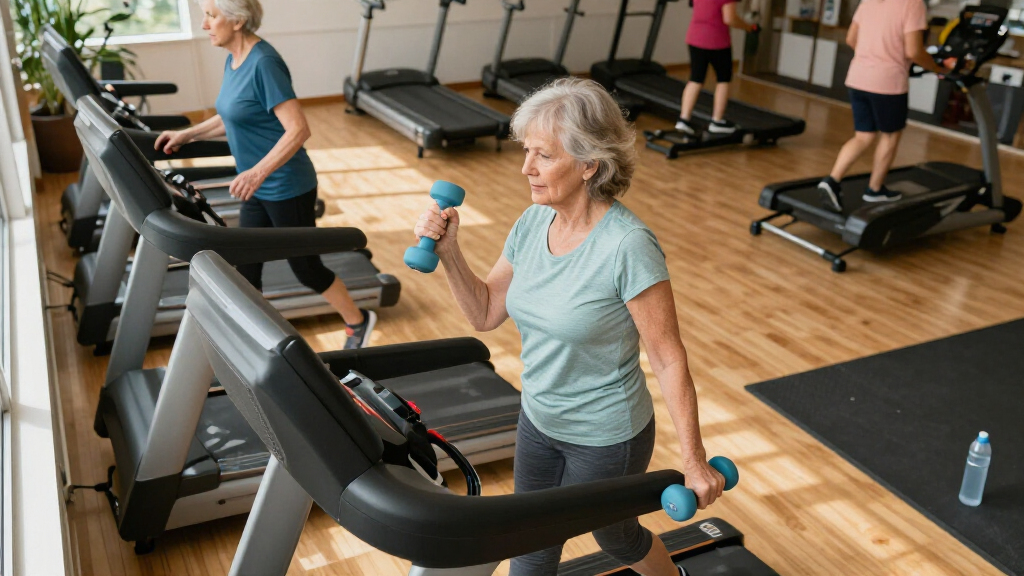
A Sixty and Me report by sports scientist and trainer Patricia Siegel argues that women over 60 should combine endurance exercise with strength training rather than choose one over the other. Its suggested weekly plan includes walking or other aerobic work, intervals, resistance training and optional impact exercises; it is guidance from the author, not a one-size-fits-all prescription.
Sixty and Me has published an exercise guide by sports scientist and personal trainer Patricia Siegel arguing that women over 60 should combine endurance exercise and strength training, rather than rely on cardio or weights alone. The article offers a sample weekly routine, but its training targets are the author’s recommendations, not a personalized medical or exercise prescription.
Siegel’s suggested endurance work includes Zone 2 exercise twice a week for about 35 to 45 minutes. She describes the effort as a conversational pace: people should be able to speak a few sentences but not sing. Walking is presented as an accessible starting point, with the advice to increase the challenge over time through pace, terrain or another activity as fitness improves.
The guide also recommends interval training once or twice a week, beginning with a short hard effort followed by a longer recovery. For strength, Siegel suggests three weekly sessions, using either full-body workouts or a split between upper- and lower-body days. Her example is three to four sets of 10 to 12 repetitions, with a weight that leaves about two repetitions in reserve. She also says impact movements, such as heel drops or hops, may be added when they can be done safely.
The sample week alternates lower-body strength, aerobic sessions, intervals and upper-body strength, with one rest day. The article does not establish that this exact schedule is suitable for every reader or report results from a clinical trial testing the plan.
Why Combine Cardio and Strength
The guide addresses two different aims: endurance exercise supports cardiovascular fitness, while resistance exercise challenges muscles and bones. Its central point is that treating the choice as cardio versus strength may leave an important part of a balanced routine out. For older adults, the issue has practical relevance because maintaining strength and aerobic capacity can support everyday movement and physical function.
Siegel’s proposed schedule is also a reminder that recommendations need to fit a person’s current abilities and health. The article’s general targets may help readers frame questions about exercise, but they do not determine what intensity, movements or weekly volume is safe for an individual.
As an affiliate, we earn on qualifying purchases.
The Guide’s Health Rationale
Siegel cites U.S. public-health figures to explain the need for exercise. The source article says 13.9% of Americans aged 65 and older met both aerobic and muscle-strengthening guidelines in their leisure time in 2022; it gives rates of 16.8% for ages 65 to 74, 12.3% for 75 to 84, and 6.2% for those 85 and older. These figures describe guideline participation, not the effects of Siegel’s proposed routine.
The article also refers to cardiovascular disease and osteoporosis risks for women. Those statistics are presented in the original report as motivation for including both forms of exercise, rather than as evidence that one particular program prevents disease or fractures. Siegel identifies herself as the author of a forthcoming book on menopause, strength and endurance training, planned for spring 2028.
“During the exercise you would be able to speak a few sentences but won’t be able to sing.”
— Patricia Siegel, describing Zone 2 exercise in Sixty and Me
light resistance bands for seniors
As an affiliate, we earn on qualifying purchases.
As an affiliate, we earn on qualifying purchases.
Limits of the Suggested Routine
The source does not give a publication date, cite research for each specific workout target, or explain how the schedule was evaluated. It also does not address how the plan should change for people with chronic conditions, pain, prior injuries, balance limitations or different levels of fitness. The safety and suitability of impact work such as hopping or jumping will vary by person.
The figures and health claims are reported by Sixty and Me, but the article does not provide enough detail here to independently assess their underlying sources. Readers considering changes to exercise intensity or adding impact training should discuss personal limitations with a qualified health professional or appropriately credentialed exercise specialist.
low impact exercise equipment for seniors
As an affiliate, we earn on qualifying purchases.
As an affiliate, we earn on qualifying purchases.
How Readers Can Apply the Advice
Siegel’s article invites readers to compare the sample week with the activity they currently do and consider what may be missing. Its practical next step is gradual progression: start with a manageable aerobic pace or resistance level, then adjust as capacity allows, rather than immediately attempting the full schedule.
The source provides no announced follow-up study or formal assessment of the plan. Any further guidance may come through Siegel’s planned book, listed in the article for spring 2028; its publication and contents are not confirmed beyond that stated plan.
As an affiliate, we earn on qualifying purchases.
Key Questions
Does the article recommend cardio or strength training?
Both. Siegel argues that women over 60 should include endurance exercise as well as resistance training, rather than choosing only one category.
How much Zone 2 exercise does the guide suggest?
The guide suggests about 35 to 45 minutes twice a week, at a pace where a person can speak a few sentences but not sing. These are the author’s general recommendations.
What strength-training schedule does Siegel propose?
She suggests three strength sessions per week, either as three full-body workouts or a split that includes upper- and lower-body sessions. She gives three to four sets of 10 to 12 repetitions as an example.
Is the sample plan suitable for everyone over 60?
No. The article does not tailor the routine to individual health conditions, injuries, balance or fitness levels. People who are unsure about exercise safety should seek guidance from a qualified professional before making significant changes.
Source: rss
Cold & flu season Picks
humidifiers
As an affiliate, we earn on qualifying purchases.